7 min read
© The Indian Express Pvt Ltd

Journalism of Courage



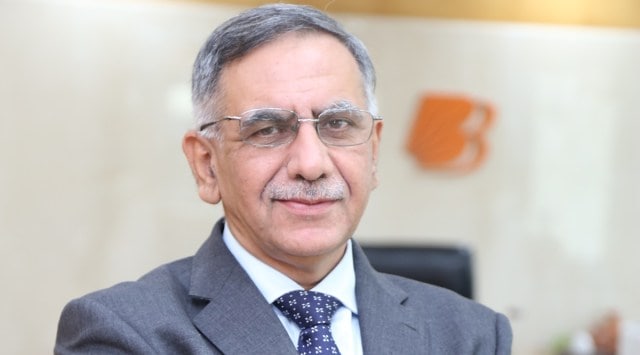 Sanjiv Chadha (Image source: DSP)
 Bank of Baroda (BoB) Managing Director & CEO SANJIV CHADHA says the higher growth in the retail loans was mainly on account of pent-up demand and was also supported by the base effect and there will be some moderation in the segment going ahead. In an interview to HITESH VYAS and GEORGE MATHEW, Chadha, who was Deputy MD with SBI before moving to BoB, the third largest public sector bank, in January 2020, said, “the credit growth will also moderate to about sustainable levels for the next few months.” Excerpts:
Your retail book grew by 29 per cent. Is this growth sustainable?
To my mind 29 per cent growth is an outlier. I don’t think you can sustain 29 per cent growth on an ongoing basis. Part of this (higher retail growth) came from pent-up demand and from base effect. It is something which will moderate.
As a bank, we have a stance that we want to rebalance our portfolio and make it a little less corporate-oriented and a little more retail-oriented. Therefore, if you look at our book over the last 1.5 to 2 quarters, almost every quarter our retail book has grown significantly faster than corporate. We believe that at the end of the cycle, we should have a more balanced portfolio. Today the corporate portfolio looks very good, but the fact is that cycles always change and when the corporate cycle changes, the impact can be disproportionate as they are chunky loans.
How do you see credit demand in a rising interest rate scenario?
As a general proposition, the sequence will be – the economy starts improving, demand becomes more broad-based, companies start investing. When all this happens, credit growth starts taking place. After that you might have inflationary pressures which start building up, and because of that the central bank feels that it needs to normalize the interest rate cycle as rates had been cut when the economy was weak. Therefore, normalization of the cycle happens which in turn will have some impact on demand as you go forward. The credit growth will also moderate to about sustainable levels for the next few months.
Are you saying the current credit growth rate is not sustainable?
To my mind, yes. Our car loans for instance grew by 29 per cent year-on-year (y-o-y) and the industry also grew. Car sales itself grew by 44 per cent. Now nobody can argue that car sales are going to grow by 44 per cent indefinitely. There was obviously pent-up demand and also a base effect. Because the first quarter of last year was a disaster on account of the second wave, you find that the GDP growth this year (in Q1) was as high as 13.5 per cent. In the second quarter (of Q2 FY23), it has come down to 6.3 per cent because the recovery had happened after the second wave. So, we have to see it in that context and not get carried away by the quarter-on-quarter fluctuations, which has been distorted very substantially by the base effect on account of Covid.
Where is the credit demand coming from?
It is a mix. The capital investment has happened from the government side. The government has made very large capital investments, for instance, in the road sector. This has a second order effect on demand for cement, construction sector and steel. Demand is coming from companies which have started investment because of the fact that capacity utilization rates are moving up. And lastly, the demand is also being generated as there are investments happening in transition from thermal to renewable energy, shift in the automobile sector from internal combustion engines to electric, among others.
What is your assessment of the Indian economy?
There is a broad-based recovery which is happening. It started pretty much with the infrastructure sector where the government, as part of its Covid stimulus, made a lot of investments. Infrastructure means that there is a second order effect which has happened in terms of demand for cement and steel. A lot of investment is happening in renewable energy. The chemical and pharmaceutical sectors have done very well.
Also, you have reached a stage where capacity utilization levels are now around 70 per cent. It is a generally accepted axiom that when capacity utilization levels are at 80 per cent, companies start looking to invest to cater for future demand. There is a capital investment cycle also which is now being triggered. While India is recovering and recovery is becoming more and more broad-based, we will not have the kind of growth rates that we had when the global environment was also benign. Our assessment is that we should have a growth rate of about 7 per cent or thereabouts.
Do you expect NPAs to rise along with an increase in credit?
I would not think so. Interest rates have normalized. They have not reached a level which is out of sync with past patterns. Even now they are barely positive on an inflation adjusted basis. When Covid came, there were a lot of central banks that took drastic action in terms of reducing rates. Due to this they need to take drastic action now to increase rates and to bring them back to normal. Since in India, the rate of decrease was moderate, the rate of increase is also moderate. Hence, it will not be disruptive.
There does not seem to be anything, as of now, on the horizon which will suggest that any increase in interest rates or any stress, which is left in the economy, can impact books of banks.
Where are your slippages coming from?
Slippages are coming majorly from the MSME book, which is where the restructured book has the propensity to slip. As the MSME segment was most impacted by Covid, they were given a lot of assistance in terms of government support through ECLGS loans. A lot of them have come out of the stress but there is a significant percentage which is struggling. Even the structure of the economy is also changing… there will be businesses that will not be viable as we go ahead. However, we are not averse to the MSME segment. Our book in the segment is growing in double-digit.
In retail also there is some (stress), but it is much less than what we thought. In fact, from my perspective, the biggest positive surprise after Covid was how the retail sector performed. Over the last six quarters, our NPA percentage in the retail book has come down successively on a quarter-on-quarter basis.