5 min read
Stay updated with the latest - Click here to follow us on Instagram

Journalism of Courage



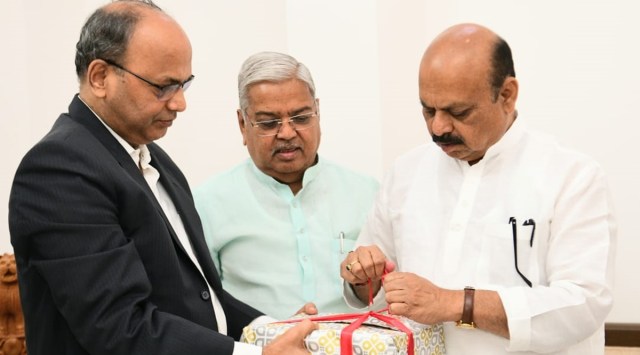 Former Karnataka chief secretary T M Vijay Bhaskar who heads the state Administrative Reforms Commission presented the fourth and fifth reports to Karnataka CM Basavaraj Bommai. (Express Photo)
 The fourth and the fifth reports of the Administrative Reforms Commission presented a host of suggestions, key among them are possible reforms in the education and healthcare sectors.
The reports were presented Friday to Karnataka Chief Minister Basavaraj Bommai by T M Vijay Bhaskar, convenor of the Karnataka commission and former chief secretary of the state. According to a statement, the reports involved visits to districts, cities and towns across the states, consultations with elected officials and citizens, as well as study reports from reported institutions — a total of 1,609 suggestions.
For the educational institutions, it was suggested that 6,307 anganwadi buildings in rented premises within 300 metre of the schools could be shifted to the school premises if possible. Several school mergers have also been suggested to combat dropout rates, including lower and higher primary schools into higher primary schools and high schools and PU Colleges into Karnataka Public Schools.
It was also suggested that the process of three admissions and transfer certificates between classes 1 and 12 in Cluster Schools and Karnataka Public Schools could be stopped. The reports also took note of the fact that the pass percentages of Classes 11 and 12, which are roughly on par with Andhra Pradesh and Telangana and about 15-30 per cent lower than the rest of the neighbouring states, are disproportionately affecting SC/ST communities.
To rectify this, it was suggested that an internal assessment could be introduced along with 20 marks of MCQ questions for Science and 15 marks for Language/Social Sciences. It was also proposed that the theory paper minimum could be reduced to 20 marks. The report also suggested that gram panchayats and urban bodies going from below 90 per cent to 100 per cent literacy could be granted awards.
Regarding the rural quota for MBBS seats, several suggestions were put forth, as CBSE and ICSE students were taking the lion’s share of these seats at 51 per cent. It was suggested that it could be 1) converted to a quota for rural government schools, 2) the same but with SSLC private schools included and 3) reserving 7.5 per cent of the 15 per cent rural quota for government school students. An NRI quota of 5-10 per cent could also be instituted in government medical colleges for fundraising, by charging higher fees for them. Further, a weightage of 10 per cent, up to a maximum of 30 per cent, was suggested for each year of rural service to apply in the NEET PG exam.
Among healthcare concerns were nutrition and maternal/infant mortality. It was suggested that taluk hospitals with high workloads be assisted with additional specialists as well as postgraduate students. To enable evening OPDs at government hospitals, it has also been suggested that private practice by government doctors should be banned.
It was also suggested that severely and moderately malnourished children be provided five eggs a week, while other children would receive two. Disability rehabilitation would also be covered under Ayushman Bharat Arogya Karnataka. With regard to veterinary services, it was suggested that proper facilities and funding for medicine purchase be required. It was also suggested that surplus vet clinics be shifted to the districts of Belgaum, Koppal, Raichur and Bellary since they had a shortfall of 154 clinics.
A 50 per cent subsidiary has also been suggested for nurse midwives and male health workers to purchase two-wheelers, along with a suggestion to open nursing colleges with 20 nursing seats and 10 paramedical seats in taluk hospitals with high workload and 100 beds.
Several suggestions were also made in the agricultural field, namely, to focus on post-harvest management, in a PPP model to improve the productivity of the sericulture department and also for fish seed production by the fisheries department. It was also suggested that an e-auction system for silk cocoons could be set up to benefit farmers, while a software system to monitor prices outside market yards could also be set up.
With regard to administrative efficiency, it was suggested that the membership of the Karnataka Public Service Commission be reduced from 14 to eight, and that the Commission stop document verification, as it could be handled by the relevant department. It has also been suggested that 30 posts for Deputy Commissioners of the BBMP be created.
Stay updated with the latest - Click here to follow us on Instagram