3 min read
Stay updated with the latest - Click here to follow us on Instagram

Journalism of Courage


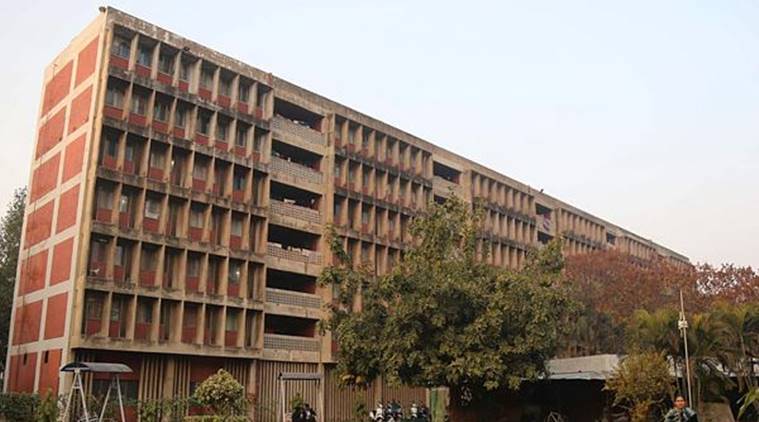 Among these reforms is a plan to launch a student portal to interface with university officials which would work like a virtual private network (VPN). (Representational Image)
Sample these queries: Results declared but showing cancelled, detailed marksheets and degrees not received, students want to know admission procedure, the procedure for verifyng transcripts, getting provisional degree and duplicate marksheets, information on re-evaluation results, entrance tests, date sheets, examination centre. The list goes on.
Normally, exam-related queries are forwarded to the concerned branches for sending suitable replies to the mailer. But, in many cases, one mailer sends the same query to the vice chancellor, registrar, dean of student welfare, Dean of University Instruction that is forwarded to the CoE’s office. According to information, Panjab University receives 30-35 exam-related emails on an average from students daily. This has prompted the office of the Controller of Examinations (CoE) to strengthen the student-exam staff interaction. In its ambitious plan to streamline these processes, PU has launched the online college information module as part of “examination reforms” for affiliated colleges and departments.
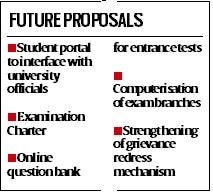
Among these reforms is a plan to launch a student portal to interface with university officials which would work like a virtual private network (VPN) similar to the 24-hour secure module available as a link between the university and all its 186 affiliated colleges, said CoE Parvinder Singh. “This system is used for sharing data, applications and other useful information, so I thought it could be done for students too. It is the right of the students to get access to exam-related solutions,” added Prof Singh.
Other plans include examination charter, online question bank for entrance tests, hi-tech workstations, phase-wise computerisation of exam branch, intranet, online verification of testimonials and strengthening the Examination Grievance Redress Mechanism (EGRM). “There is no sharing of data among branches and departments because we don’t have intranet. Officials are reluctant to work on such systems, but all our students are products of the technology boom, so we want to make it easier for them,” further stated the CoE.
The university has the single window enquiry and the exam grievances portal where approximately 500 people register their queries. The window also receives 300 phone calls with officials sometimes attending to queries on their personal mobile numbers after office hours. This enquiry system also prepares passes for students visiting university officials in the Administrative Block.
Other facilities available include online exam forms for undergraduate and postgraduate courses, VPN for uploading internal assessment and practical awards, EGMS since March 2016, online admit cards for all candidates, unique examiner management portal since 2017, National Academic Depository (NAD) implemented this year and online re-evaluation forms.
Prof Singh said, “Under NAD, the university will now award e-degrees for which our officials are undergoing training. This will also be open to colleges next year. Re-evaluation is one click away now and we are directly communicating with all college principals and directors of regional centres.” NAD is a 24×7 online storehouse of all academic awards duly digitised by academic institutions. It is secure and any student can become a member through a unique ID and will not be required to carry documents physically.
Stay updated with the latest - Click here to follow us on Instagram