Journalism of Courage


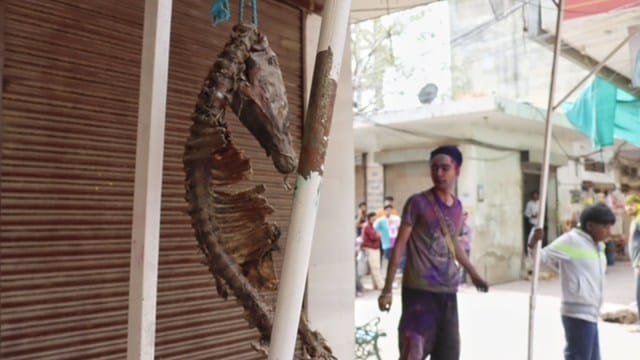 Although efforts have been made to put an end to this bizarre Holi tradition, it remains deeply ingrained in the village’s history. (Express Photo/Jasbir Malhi)
 Sohana, a village in the Sahibzada Ajit Singh Nagar district, is well known for its Gurdwara Singh Shaheedan. However, it is also infamous for a unique and unsettling Holi tradition. Unlike the vibrant festival of colours celebrated across India, Holi in Sohana has long been associated with animal carcasses, skeletons, and ashes from cremation grounds. This practice has led many to call it Punjab’s “dirtiest” Holi.
With a dense population, the village has upheld this tradition for centuries. On the night before Holi, some residents hang skeletons outside their homes, while animal carcasses are scattered across the streets. The gruesome sight of bones, skulls, and decayed remains gives the village an eerie atmosphere. Yet, despite its unsettling nature, no one raises objections.
For some, this practice is purely for “entertainment,” while others believe “it protects the village from evil spirits.”
Surjeet Singh, an 80-year-old village elder, shared insights into the origins of this tradition. He recalled that in the past, Sohana was a major marketplace for surrounding villages. People from nearby areas would stock up on essential goods before Holi, as the market traditionally remained closed for nearly a week after the festival due to the ghastly sight of animal remains and ashes covering the streets.
He recounted a story he had heard as a child: “Sohana was once cursed with poverty. To ward off this curse, villagers began hanging animal skeletons outside their homes.” He further explained that in earlier times, when people could not afford colours, they used ashes from kitchen stoves instead. Over time, this evolved into throwing ashes collected from cremation grounds.
Ex-councillor Surinder Roda recalled another explanation. According to village elders, an epidemic once broke out in Sohana around Holi, leading villagers to stop celebrating the festival. Instead, they began hanging skulls outside their houses, believing this would prevent future misfortunes.
Harjinder Kaur Baidwan, the current municipal councillor, said that in 2008, the police intervened and urged villagers to stop celebrating Holi in this manner. While the practice has declined significantly since then, it has not disappeared entirely. “Many villagers still consider this an old tradition and believe in preserving it,” she said.
Amrik Singh, a local resident, added, “Hanging skeletons outside our homes keeps evil spirits happy. We saw our elders do this, and now it has become a tradition. No one knows exactly when it started, but it has been passed down for generations.”
Parminder Singh Sohana, another resident and a political leader, remarked, “Over the years, this tradition has faded. However, many youngsters between 18 and 32 still participate in it just for fun. We are gradually moving towards eradicating it.”
He further explained, “In ancient times, Sohana was a village of dairy farmers. The land was barren, and water was scarce. Since the villagers could not afford colours, they started playing Holi with ash instead.”
Nachhatar Singh Baidwan, a farmer leader from Sohana, said, “This tradition existed long before I was born. While it may seem shocking, it has been part of our village’s history.”
He added, “In the past, people collected ashes from the cremation ground and mixed them with sewage water to smear on each other’s faces. But now, with education and awareness, many villagers have abandoned this practice. However, some still follow it.”
Ashok Verma, a local shopkeeper, confirmed this, saying, “We have become accustomed to it. Holi has been celebrated like this for many years. We usually stay inside our homes because going out can be quite unsettling.”
Although efforts have been made to put an end to this bizarre Holi tradition, it remains deeply ingrained in the village’s history. While younger generations are moving away from these rituals, the eerie remnants of Sohana’s unique Holi can still be seen, making it one of India’s most unusual Holi celebrations.

 4 min read