Journalism of Courage



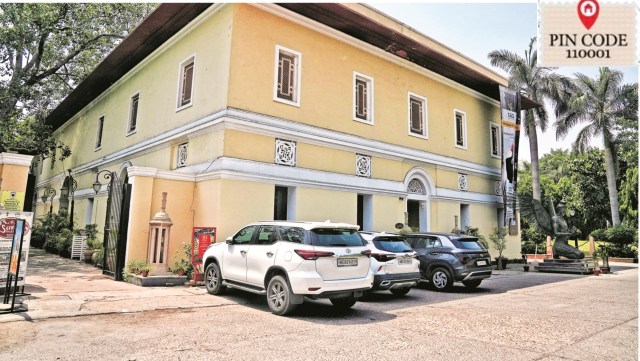 Built during the rule of Maharaja Ganga Singh (1887-1943 AD), it served as the Delhi residence of the royal family. (Express photo by Abhinav Saha)
As the road circles through the India Gate hexagon, a couple of chhatris (canopy styled domes), a marker of Rajput tradition, can be spotted from a distance. Coming closer, a narrow path leads to sandstone high walls, housing the Bikaner House, which was designed in the early 20th century as the Delhi residence of the rulers of the princely state of Bikaner — now a city in Rajasthan.
Built during the rule of Maharaja Ganga Singh, the king of the princely state of Bikaner (1887 to 1943 AD), it served as the Delhi residence of the royal family.
According to Sumanta K Bhowmick, the author of the Princely Palaces in New Delhi: “When (English architect) Edwin Lutyens was planning Delhi in 1912, a Princes’ Park to accommodate the palaces of the princes was envisaged. At the time, India was divided into two sections — British India and Princely India. The latter housed many important kingdoms.”
In June 1912, a request was sent out to all the princes that they could apply for land in Delhi if they wished so. “A rule was made: No one would get more than eight acres of land,” Bhowmick told The Indian Express.
Since most of the royalty preferred to live near those belonging to their region, all of the houses from Rajasthan — such as Jaipur House — were situated in the same area.
“Likewise, at Mandi House, one would find all of the houses of the Punjab state. One of the earliest houses to be built were the Hyderabad House and the Bikaner House…,” according to Bhowmick.
Despite his wealth, the king of Bikaner wanted a modest abode in Delhi. “Maharaja of Bikaner was a humble person. He was a very disciplined and scholarly man who did not like to show off. He ordered his palace to be a small one,” added Bhowmick.
Like all palaces built during the British rule, the Bikaner House too had a fireplace in the dining area, which signified an English influence.
While renowned architects, Lutyens and Herbert Baker, were initially considered for the project, the responsibility to build it ultimately went to Charles G Blomfield. The resulting architectural style leaned westward, with a distinct Rajput touch evident in the chhatris.
However, Bikaner House did not have a waiting area. “The king never wanted people to wait around and chat. Which is why you will not find a waiting area here,” explained Bhowmick.
During its time as a royal residence, the ground floor buzzed with activity in reception areas, private chambers, and guest rooms. The first floor housed the zenana, the traditional quarters for the women of the household.
Bikaner House officially opened on February 18, 1929, with a grand house-warming party for esteemed guests.
Notably, in the lead-up to India’s Independence in 1947, the premises became a crucial setting for meetings among royal families. It is here that they charted their futures and considered the path to join the newly independent nation.
Recognised as a Grade II heritage building by the Archaeological Survey of India (ASI), Bikaner House underwent meticulous restoration a few years ago to recapture its former glory. In 2015, it reopened its doors to the public, having transformed into a cultural centre under the Rajasthan government’s stewardship.
“The Govt of Rajasthan registered Bikaner House Management Society (BHMS) in April 2016 to dedicate Bikaner House to the exploration of interdisciplinary activities in Arts, Heritage and Culture.
The main objective of the Bikaner House Management Society is to develop Bikaner House as a premier arts and culture hub in the nation’s capital for state and national-level events,” according to the website of the Bikaner House.
In a social media post, historian and author Sam Dalrymple called the Bikaner House as one which was considered “perhaps the most impressive and ambitious architectural feat constructed anywhere in the British Empire”.
He further said: “Carved out of sandstone, its Hindu chhatris, Mughal gardens and Buddhist stupa-like domes were meant to represent the diversity of the Indian Empire in stone, and as far as most people were concerned, it was a masterpiece.”



 4 min read