Journalism of Courage


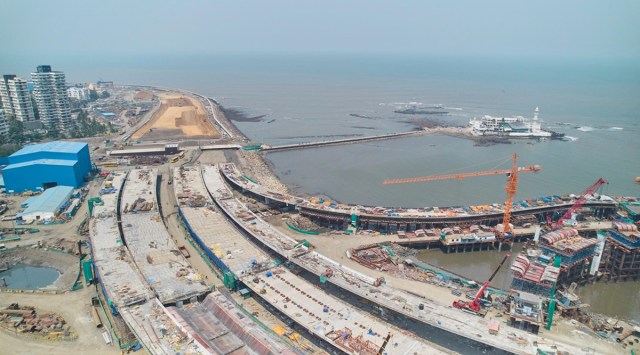 The site of the coastal road project in Mumbai. Express file
 The Brihanmumbai Municipal Corporation (BMC) will highlight the disaster resilience capacity of the Mumbai Coastal Road Project (MCRP) in the upcoming G20 second Disaster Risk Reduction Working Group (DRRWG) meeting to be held in Mumbai between May 23 – 25.
Stretched along the western coastal stretch of Mumbai, the 10.58km long road is going to be a high speed corridor that will connect the Princess Street Flyover in Marine Drive with the Bandra Worli Sea Link (BWSL) through a series of tunnels, arterial roads, traffic interchanges and flyovers. Currently, the the project is in the final stage of construction and is expected to be made operational by the end of this year.
Days ahead of the DRRWG meet, additional municipal commissioner Ashwini Bhide, who is spearheading the project, said measures to tackle probable disasters have been factored in within the project design.
“About 13.6% of the project area is earmarked for the construction of a safety wall which will protect against sea waves. The 8.5km long sea-wall is built in such a way that marine life will flourish while corrosion, soil erosion and tidal effects will be taken care of. This will also be an important issue for disaster management matters,” said Bhide in a statement released by the Ministry of Home Affairs.
“For the construction of the wave wall…the highest level of flood has been taken into account. It is going to act as a protection…from flood and storm surges. These are going to be beneficial not just to the coastal road, but to that section of the city as well,” said Bhide. The highlight of the project is the 2.07km-long twin tunnels that will originate in Girgaon and run below the Arabian Sea, adjoining Girgaon Chowpatty, moving northwards from below Malabar Hill.
Elaborating further on the disaster resilience features within the tunnel, civic body officials said that it has been equipped with essential fire protection measures in a manner designed to resist upto 100MW fire for three hours.
“Saccardo ventilation system provided with the tunnels will improve ventilation and air flow. Hence, in case of a fire in one tunnel, the other will remain smoke free,” read the statement.
Besides this, with an aim to counter floods and related disasters, the project has extended the existing storm water drainage network beyond the sea wall.
Bhide said two colonies of corals, which had been discovered in the sea during construction, were successfully translocated to other locations by experts of the National Institute of Oceanography (NIO).
With the Coastal Road nearing completion, there are also plans to have a control command centre, which will monitor the operations on the road with the coordination of the BMC disaster control room and traffic control room of Mumbai Police.

 3 min read