8 min read
Click here to follow Screen Digital on YouTube and stay updated with the latest from the world of cinema.
© IE Online Media Services Pvt Ltd


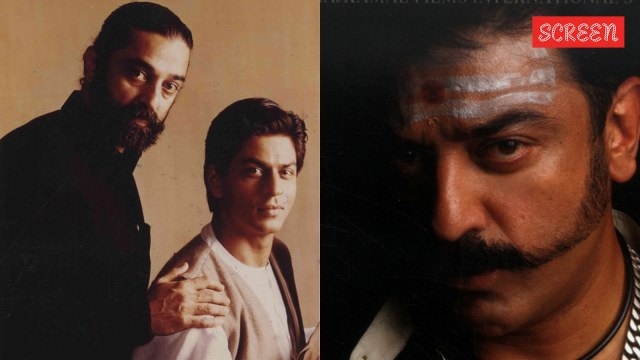 As Kamal Haasan turns 70, we revisit two of his finest films, Hey Ram and Virumaandi.
Unlike most actors who venture into direction occasionally, Kamal Haasan could have built an equally formidable career solely as a filmmaker had he chosen to. His directorial works stand apart as intellectually charged, formally inventive films that resist easy genre labels and commercial compromise. This uncompromising artistic streak is most evident in the twin landmarks of his filmography: the revisionist historical epic Hey Ram (2000) and the Rashomon-inspired rural drama Virumaandi (2004).
These films stand as monuments to Kamal Haasan’s directorial ambition, marked by a restlessness to push confrontational themes through the framework of mainstream cinema. They are unafraid to be violent, messy, hard-hitting, and sprawling, yet they never lose sight of the clear artistic argument at their core. Hey Ram is a film of staggering intensity, a masterclass in revisionism and genre blending, where historical narrative collides with raw personal conviction. On the other hand, Virumaandi plays like the work of a social realist steeped in the traditions of European auteurs, challenging the very boundaries of what mass-market Indian cinema can contain.
In Hey Ram, his second outing as a filmmaker, Kamal Haasan fuses the country’s history of reactionary violence and political bigotry into a masterful subversion of the biopic sub-genre. By crafting a fictional biography around Saket Ram, he mirrors the turmoil of pre-Independence India, compressing decades of ideological conflict into a single man’s moral and emotional descent. The film charts the revenge-driven journey of an archaeologist shattered by personal loss and swept up by the forces of communal hatred, ultimately evolving into Kamal Haasan’s argument for secular empathy and the dangers of religious division. Remarkably, Kamal refuses to dilute his historical rigor, cultural critique, or political sharpness, even while mounting Hey Ram as a mainstream theatrical release intended for a wide audience.
Set against the nightmarish backdrop of the 1946 Calcutta Killings and the murder of Saket Ram’s wife by a communal mob, the film adopts an allegorical approach to personalise the trauma of a nation on the brink of violent upheaval. Consumed by grief and rage, Saket comes to believe that the only way to ‘fix’ the Hindu-Muslim divide and restore the country’s moral fabric is to assassinate the man he holds responsible for it all, Mahatma Gandhi. This is a daring critique rooted in a deep understanding of India’s conflicted history, and in a compassionate reflection on what true patriotism might mean. By following Saket’s descent into a futile, violence-fuelled revenge fantasy, Hey Ram ultimately reveals the emptiness of hatred and extremism, and, in doing so, reaffirms Gandhi’s message in its full moral clarity.
Also Read | 35 years of Gunaa: Kamal Haasan is hypnotic in this eternal romantic classic
Most filmmakers would hesitate to tackle the subject of religious fundamentalism, especially in the current climate. But Kamal Haasan uses the framework of a character study to explore the hypocrisy and bigotry present on all sides, approaching the subject with nuance and sensitivity. The film refuses to villainise any one community or ideology in a simplistic way. Instead, Kamal draws on his artistic credibility and cultural standing to articulate a vision of a more hopeful future, one in which people can coexist despite their differences.
He uses Shah Rukh Khan’s character Amjad Ali Khan as a symbol of the optimistic, secular worldview he hopes to instill in a society filled to the brim with hate and intolerance. The masterstroke of casting a star of Shah Rukh’s stature in such an extended, but vital cameo ensures that the messaging cuts through without being lost in the noise of the spectacle. This was the original ‘pan Indian’ film decades before that flexible word was abused by modern filmmakers. The potency and immediacy of the story naturally made it something with nationwide resonance and the casting ensured that the message was delivered loud and clear.
In a pivotal scene toward the film’s final act, a horrified Amjad Khan responds to Saket Ram’s plan to assassinate Mahatma Gandhi by saying, “Gandhi is the only sanity in this country.” He then adds, with a quiet, pained clarity, “You have gone mad, Ram. You have gone mad.” This exchange functions as the film’s thesis, Kamal Haasan’s commentary on a nation unravelling under the weight of half-truths, propaganda, and hatred. And tragically, the insight still resonates today.
Hey Ram is as much a technical achievement as it is a narrative one. Kamal Haasan maintains precise control over the camera, favouring a classical approach to staging and composition that gives the film a strong visual coherence. The riot sequences and moments of violence are filmed with striking clarity, while the quieter conversational scenes are framed in ways that subtly underline the film’s philosophical undercurrents. Saket Ram’s internal conflict is mirrored in the film’s structure, which moves between past and present, with the older Saket, in 1999 and near death, narrating his turbulent life in monochrome flashbacks. Kamal avoids didacticism; he does not lecture the audience. Instead, he observes the clashing ideologies and perspectives of the era and weaves them into a bold meditation on nationalism, identity, and guilt. In the process, he also delivers one of his most haunting performances.
Kamal Haasan bore the financial burden of Hey Ram’s underperformance at the box office. Yet, in the 25 years since its release, the film’s warnings and political insights have only grown more disturbingly prescient.
Unshaken in his artistic conviction, Kamal returned four years later with another remarkable directorial achievement: Virumaandi (2004). This time, he scaled down the visual grandeur and production scale, but retained the sweeping emotional and thematic ambition. The film may look more grounded, but the urgency of the questions it raises is just as vast and just as challenging.
Virumaandi follows a death-row inmate who recounts the events that led to his conviction, only for his rival to offer a starkly different version of the same story. Through these conflicting narratives, the film questions the possibility of objective truth and exposes how moral certainty collapses in the debate over capital punishment. The film represents a significant artistic progression for Kamal Haasan. He leans into the drama of small moments, creating tension not only through dialogue but also through silence. Virumaandi shows a filmmaker who has sharpened his cinematic language, asking uncomfortable questions with renewed grit and clarity.
Kamal Haasan uses the device of multiple characters recounting their own versions of events to democratise the narrative, giving each perspective equal weight and legitimacy. Every creative decision in Virumaandi is tightly bound to the film’s thematic intent, and Kamal avoids any overt display of directorial flamboyance. He allows the story to unfold with organic tension. Yet, his instinct for framing and composition is so precise that the film’s grounded, granular screenplay transforms into a visceral, lived-in crime drama, the work of a seasoned filmmaker uniquely capable of orchestrating on-screen chaos with total control.
Originally titled Sandiyar, a nod to the caste pride embedded in the film’s rural setting, Virumaandi faced controversy from the moment it was announced. The film is brutally unflinching in its depiction of violence, refusing to soften or stylize the harsh realities it portrays. In the context of Tamil mainstream cinema at the time, this was a significant artistic risk: a popular star at the peak of his career was choosing to make a film that was raw, uncomfortable, and politically charged. Yet Kamal Haasan leaned into these challenging choices. In doing so, he helped pave the way for the more forthright, morally complex storytelling that defines much of contemporary Tamil cinema today.
Whenever Kamal steps behind the camera, he challenges the viewer, inviting them into moral, political, and emotional conflicts that reflect broader social questions. He does not adjust his filmmaking to meet the audience where they are; he expects the audience to rise to the level of the work. Yes, the films contain humor, scale, and the familiar rhythms of commercial cinema, but the risks remain unmistakable, even in later works like the Vishwaroopam films.
As a director, Kamal Haasan has always trusted his audience to think. He has never bowed to the safe, reassuring comforts of cinema designed merely to entertain. His directorial career is defined by bold, unguarded leaps, the choices of an artiste who values conviction above convenience. His camera has never shied away from exposing hypocrisy, complexity, and contradiction; and he has done so within the very machinery of mainstream filmmaking. The result is a body of work that dares to provoke, unsettle, illuminate, and remain deeply, uniquely his own.
Click here to follow Screen Digital on YouTube and stay updated with the latest from the world of cinema.