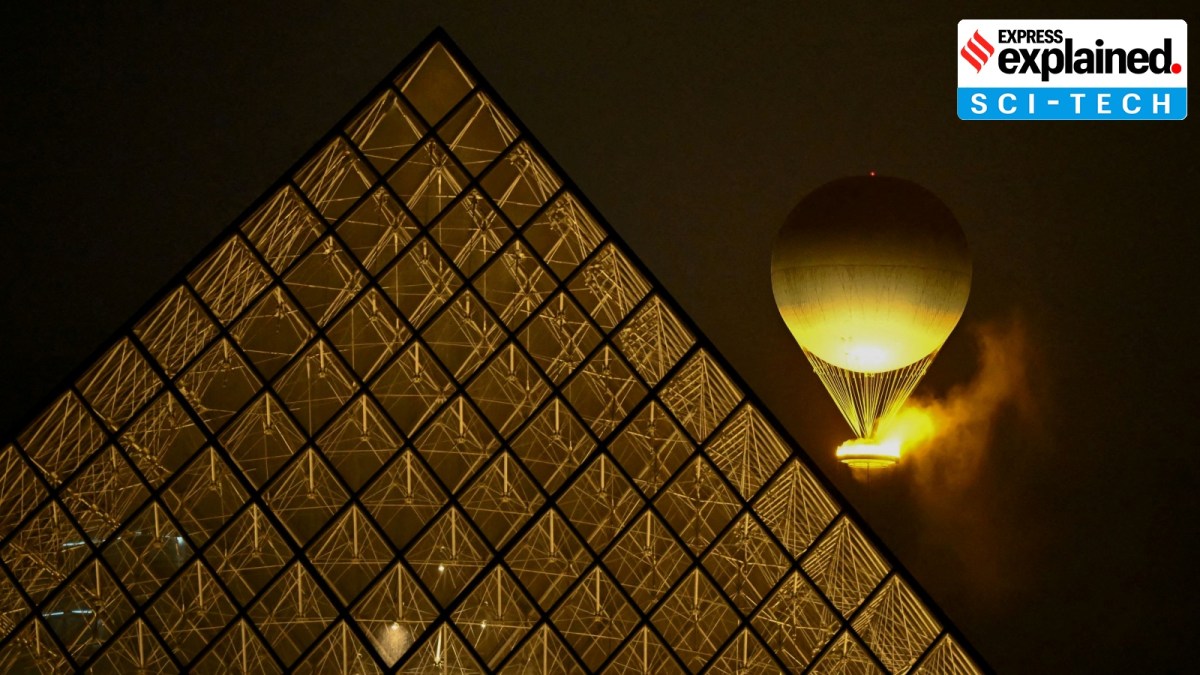
What is special about the flying cauldron in the 2024 Olympics?
Throughout Olympic history, the cauldron has been a giant fixture on the ground, usually located in or near the main stadium. Paris is the first to have a moving, floating, air-borne cauldron.
The balloon carrying the Olympic cauldron is seen above The Louvre museum. (Reuters)
Whatsapp
Twitter
Facebook
Reddit
Since the start of the Olympic Games in Paris on July 26, the iconic cauldron has been blazing away on the ground during the day. Come sunset, however, and it rises into the sky to hover 30 metres above the ground. Throughout Olympic history, the cauldron has been a giant fixture on the ground, usually located in or near the main stadium. Paris is the first to have a moving, floating, air-borne cauldron.
Here is a look at the design of the Paris Olympics cauldron.
You’ve Read Your Free Stories For Now
Sign up and keep reading more stories that matter to you.
The cauldron has been designed by a multidisciplinary French designer Mathieu Lehanneur as a hot air balloon. “The torch, the torch relay cauldron and the Olympic cauldron are not separate objects. They are chapters in one great story. Each embodies the spirit of the Paris Games. The cauldron takes the form of a ring of fire suspended above a liquid surface. Both pure and magical, it seems to float and is reflected in its metallic base. If the torch is a sacred fire that is passed on, the cauldron is the object around which we gather and which unites our energies,” according to Lehanneur.
The cauldron is a tribute to the brothers, Joseph-Michel Montgolfier and Jacques-Étienne Montgolfier, who were pioneers in creating hot air balloons. Joseph-Michel and Jacques-Étienne were a part of a family that had 16 children. Their father owned paper factories in Vidalon in the south of France, and funded and encouraged the duo’s experiments with balloons.
Joseph-Michel and Jacques-Étienne discovered that a paper or cloth bag filled with hot air would rise off the ground, float and, then, return to the ground. They conducted experiments in which they burnt straw and wool under the mouths of bags. They travelled to Paris and Versailles and demonstrated that a large balloon, holding a sheep, a rooster and a duck, could float around eight minutes and land safely about 3.2 km away.
None other than King Louis XVI was present when the Montgolfiers launched the first hot-air balloon at Versailles in September 1783. In November of the same year, the brothers launched the first manned and untethered hot-air balloon flight. It travelled 5.5 miles and carried Marquis d’ Arlandes, François Laurent, and Jean-François Pilatre de Rozier, a doctor, as passengers. This balloon travelled over Paris for 9 km for 25 minutes.
The design
Lehanneur’s cauldron design for Paris 2024 is 30 metres high. The diameter, known as the ring of fire, where the Olympic fire burns during the event, is seven metres and symbolises one of the country’s fundamental beliefs, fraternity. The cauldron aligns with the designer’s creative philosophy “Because we are a body and a spirit. / Because some objects have the power to transform us. / Because what we possess represents us, / And what we pass on will say about us.”
Story continues below this ad
The cauldron is located at Jardin des Tuileries, near the Louvre, La Concorde, and the Arc de Triomphe. This is the site from where the Montgolfier brothers had set afloat their first hot air balloon in 1783 before a crowd of 4 lakh people. In keeping with the aim of the Games to be climate-friendly, the Olympic cauldron is not lit by fossil fuel but completely by electricity. There are 40 LED lights and 200 high-pressure misting nozzles whose interaction creates the appearance of a real fire. It is only fitting that, in another first, visitors have a free entry around the cauldron to marvel at it and, of course, take selfies.
Dipanita Nath is a Senior Assistant Editor at The Indian Express, based in Pune. She is a versatile journalist with a deep interest in the intersection of culture, sustainability, and urban life.
Professional Background
Experience: Before joining The Indian Express, she worked with other major news organizations including Hindustan Times, The Times of India, and Mint.
Core Specializations: She is widely recognized for her coverage of the climate crisis, theatre and performing arts, heritage conservation, and the startup ecosystem (often through her "Pune Inc" series).
Storytelling Focus: Her work often unearths "hidden stories" of Pune—focusing on historical institutes, local traditions, and the personal journeys of social innovators.
Recent Notable Articles (December 2025)
Her recent reporting highlights Pune’s cultural pulse and the environmental challenges facing the city during the winter season:
1. Climate & Environment
"Pune shivers on coldest morning of the season; minimum temperature plunges to 6.9°C" (Dec 20, 2025): Reporting on the record-breaking cold wave in Pune and the IMD's forecast for the week.
"How a heritage tree-mapping event at Ganeshkhind Garden highlights rising interest in Pune’s green legacy" (Dec 20, 2025): Covering a citizen-led initiative where Gen Z and millennials gathered to document and protect ancient trees at a Biodiversity Heritage Site.
"Right to breathe: Landmark NGT order directs PMC to frame norms for pollution from construction sites" (Dec 8, 2025): Reporting on a significant legal victory for residents fighting dust and air pollution in urban neighborhoods like Baner.
2. "Hidden Stories" & Heritage
"Inside Pune library that’s nourished minds of entrepreneurs for 17 years" (Dec 21, 2025): A feature on the Venture Center Library, detailing how a collection of 3,500 specialized books helps tech startups navigate the product life cycle.
"Before he died, Ram Sutar gave Pune a lasting gift" (Dec 18, 2025): A tribute to the legendary sculptor Ram Sutar (creator of the Statue of Unity), focusing on his local works like the Chhatrapati Shivaji statue at Pune airport.
"The Pune institute where MA Jinnah was once chief guest" (Dec 6, 2025): An archival exploration of the College of Agriculture, established in 1907, and its historical role in India's freedom struggle.
3. Arts, Theatre & "Pune Inc"
"Satyajit Ray, Ritwik Ghatak were not rivals but close friends, says veteran filmmaker" (Dec 17, 2025): A deep-dive interview ahead of the Pune International Film Festival (PIFF) exploring the camaraderie between legends of Indian cinema.
"Meet the Pune entrepreneur helping women build and scale businesses" (Dec 16, 2025): Part of her "Pune Inc" series, profiling Nikita Vora’s efforts to empower female-led startups.
"How women drone pilots in rural Maharashtra are cultivating a green habit" (Dec 12, 2025): Exploring how technology is being used by women in agriculture to reduce chemical use and labor.
Signature Style
Dipanita Nath is known for intellectual curiosity and a narrative-driven approach. Whether she is writing about a 110-year-old eatery or the intricacies of the climate crisis, she focuses on the human element and the historical context. Her columns are often a blend of reportage and cultural commentary, making them a staple for readers interested in the "soul" of Pune.
X (Twitter): @dipanitanath ... Read More