4 min read


© The Indian Express Pvt Ltd


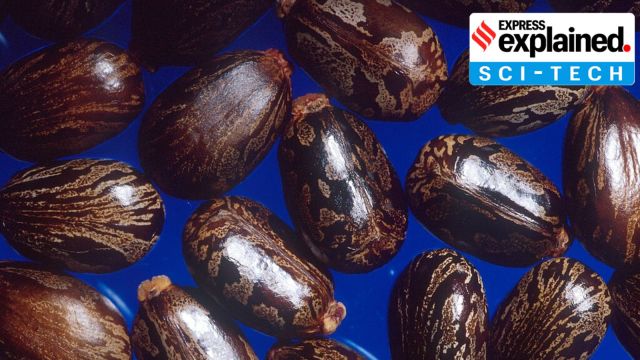 Ricin is essentially a protein that can be extracted from the castor bean. (Wikimedia Commons)
Earlier this week, the Gujarat Anti-Terrorist Squad arrested three men — including a doctor with a “Chinese medical degree” – for allegedly trying to produce a lethal chemical compound called Ricin.
The accused were allegedly planning a terror attack, for which they had surveyed the Rashtriya Swayamsevak Sangh office in Lucknow, the Agriculture Produce Market Committee in Azadpur, Delhi and the fruit market in Naroda, Ahmedabad.
The ease of producing the poison — coupled with very low doses needed to kill — makes it a challenge for law enforcement.
Ricin is essentially a protein that can be extracted from the castor bean, largely grown industrially for the production of castor oil in countries such as India, Brazil, and China. The seeds typically contain 30 per cent to 60 per cent castor oil, with ricin accounting for 1 per cent to 5 per cent of the weight of the solid residue.
“The plant is widely available, and the poison is not very difficult to extract from the seeds. Yet, the substance can be very lethal. Even 1 mg mixed in food can kill an adult,” said Dr YK Gupta, former head of the National Poison Information Centre at AIIMS, New Delhi.
Once the poison has been absorbed, it attaches itself to the ribosomes – tiny structures found in cells that are responsible for reading genetic code and synthesising proteins.
“Once the poison binds with the ribosome, it stops protein synthesis in cells. And, depending on which cells absorb the poison, a person can suffer multi-organ failure and even death,” he said.
While exposure to ricin is most likely to be a deliberate act, sometimes children may consume the seeds. “While it is not a common phenomenon, children may sometimes swallow the seeds. Usually, nothing happens even then because the seed is very hardy. However, Ricin may seep out if the seed is bitten into or cracked,” he said, adding: “When it comes to castor oil, the processing ensures that there is no ricin in it.”
Ingesting ricin can lead to severe vomiting and diarrhoea — which can become bloody – and low blood pressure. It could also lead to hallucinations and seizures, multi-organ failure, and death.
If injected, it can cause several organ systems to stop working. If inhaled, people may experience difficulty breathing, cough, and tightness in the chest.
There is no antidote or specific treatment for ricin poisoning, and the treatment is symptomatic.
“If someone comes in early enough, then vomiting may be induced to remove the poison. The stomach may also be washed to do so. However, it is likely to have been absorbed by the time one reaches hospital, in which case, the symptoms of the patient have to be managed,” Dr Gupta said.
One of the challenges with ricin poisoning is that it’s rare, so doctors don’t usually suspect it when a patient first arrives.
Because of its high toxicity and ready availability, ricin has been a subject of military interest.
It was studied as a chemical agent towards the end of World War I by the United States, but experts encountered problems related to keeping it stable at different temperatures and aerosolising – the process of converting a substance into a fine mist or aerosol that can be suspended in the air.
Limited weaponisation was achieved during World War II. The next attempt at weaponising was made in 1980, when, according to a paper by the Organisation for the Prohibition of Chemical Weapons, Iraq attempted to develop it as an inhalable aerosol.
Ricin is listed as a Schedule 1 toxin under the Chemical Weapons Convention — substances that pose the highest risk of being used as a chemical weapon. This list includes nerve agents such as sarin gas and blister agents such as mustard gas.
There have been several instances of people possessing or trying to isolate ricin at home. There have also been instances of letters sent with ricin powder, even though it is unlikely to be absorbed through skin contact.
The most widely known criminal use of the compound was to kill dissident Bulgarian journalist Gorgi Markov in London in 1978.