6 min read
© The Indian Express Pvt Ltd

Journalism of Courage


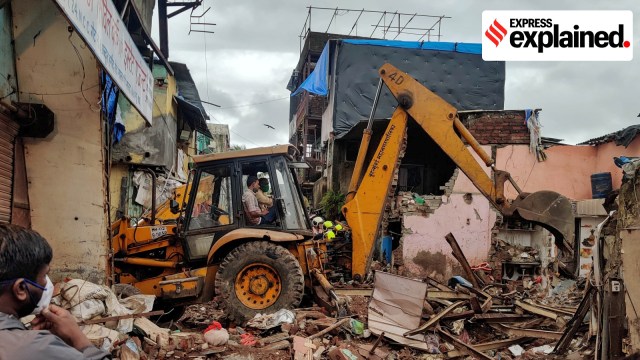 Since the debris from construction works is illegally abandoned in open grounds and dumping sites without covers and treatment, the dust from this waste remains suspended in the air, contributing further to the city's worsening Air Quality Index (AQI). (Representational image/Reuters)
Mumbai generates a whopping 8,500 metric tonnes of construction and demolition (C&D) waste daily due to large-scale infrastructural and redevelopment projects. This is significantly higher than the total solid waste garbage collected within the city which is pegged at 6,500 metric tonnes per day.
As a result, the Brihanmumbai Municipal Corporation (BMC) is struggling to tackle the collection and treatment of waste.
What is construction and demolition waste? Why is it difficult to treat it?
C&D waste refers to the concrete, dust, building material, debris and rubble generated from the construction, repair and demolition of any structure. According to officials, the major sources of C&D waste in Mumbai include waste generated during the remodelling of homes, redevelopment projects, infrastructure work, and unauthorised constructions.
Currently, Mumbai is witnessing large-scale infrastructure projects ranging from mega-concretisation works, metro projects etc., whose worksites are a major source of debris.
According to Mumbai’s Municipal Commissioner Bhushan Gagrani, the city also has more than 2,200 private construction sites.
Experts said while recycling materials such as pipes and steel are retained by the developers following a demolition, rubble and remains like concrete and dust are typically abandoned without any treatment.
Most people rope in private agencies to pick up the rubble from their remodelling projects for Rs 200-250 per metric tonne. These agencies usually dump the C&D waste in mangroves, dumping grounds etc. As a result, the debris remains strewn across the city’s open spaces, and has been mounting over the years.
Deputy municipal commissioner (solid waste management) Kiran Dighavkar said construction debris accounts for 30% of the legacy waste dumped at the Deonar dumping ground.
What are the health implications of construction dust?
Since the debris from construction works is illegally abandoned in open grounds and dumping sites without covers and treatment, the dust from this waste remains suspended in the air, contributing further to the city’s worsening Air Quality Index (AQI).
Dr Lancelot Pinto, pulmonologist and epidemiologist, said exposure to construction dust has been linked with cerebrovascular disease, COPD, respiratory infections, asthma, cardiovascular disease, autoimmune disease, cancers such as stomach, rectal and esophageal cancers, among other diseases.
“Research also shows that lung function in South Asia is over 1/3rd lower than its other counterparts,” he added, citing data from an international, community-based study on the ‘Global differences in lung function by region’. The 2013 study was conducted across 17 countries in seven different socioeconomic regions.
According to Dr Pinto, the total number of patients with prolonged cough and viral infections has increased over the years in Mumbai.
How does the BMC handle C&D waste?
Until last year, the civic body did not have any facility to treat construction debris, leaving most of the discarded waste untreated.
However, since 2023, the BMC has enhanced vigilance and started imposing penalties on violators. Data furnished by BMC show that between November 2023 and December 2024, more than 1,373 cases of unauthorised C&D waste dumping were reported. The BMC collected penalties worth Rs 72.10 lakh from violators during this period.
At the end of 2024, the BMC commissioned processing plants — one at Dahisar, another at Shilphata — which have the capacity to recycle and treat around 600 metric tonnes of C&D waste daily. While the facility at Dahisar caters to waste brought-in from the western suburbs, the debris generated within the city and eastern suburbs is ferried to the Shilphata unit in Thane.
The plants also offer the “debris on call” service, which allows citizens to submit a request for picking up debris from their doorstep or any given location. The civic body levies a charge of Rs 400-500 per metric tonne for the collection of the C&D waste.
The recycling plant crushes the waste material and washes the sediments away. The extracted plastic items are sent to cement manufacturing industries for reuse in production. The remaining aggregate materials that are obtained as an end product are recycled into sand or tiles which are later used as raw materials for infrastructure projects.
What challenges has the BMC been encountering?
Despite the establishment of the new plants, BMC officials admit that these units are equipped to handle less than 10% of the total C&D waste that the city generates daily. Even as Mumbai generates more than 8,000 metric tonnes of C&D debris every day, the BMC’s processing plants for the debris waste are currently equipped to handle only 1,200 metric tonnes of waste per day.
Even the existing facilities are drawing feeble responses from citizens. Two months after their commissioning, these two units have collectively handled only 10,400 metric tonnes so far. Senior officials said these plants are operating at only half their actual capacity.
What is the BMC’s plan to manage C&D waste?
Eyeing to acquaint citizens with its new processing plants for construction debris, the civic body is also charting plans to slash the current rates of C&D collection fee by half to bring them down to around Rs 200 per tonne.
Since the processing of construction debris was not mandatory under the solid waste management rules of 2016, the BMC is now also gauging the possibility of making the generator or contractors responsible for taking care of the C&D waste from their work sites.
However, Mumbai has a long way to go. According to data shared by Dr Rakesh Kumar of the Society for Indoor Environment (SIE), the recycling percentage of debris waste in developed nations currently stands at over 80%.