© The Indian Express Pvt Ltd

Journalism of Courage
 8 min read


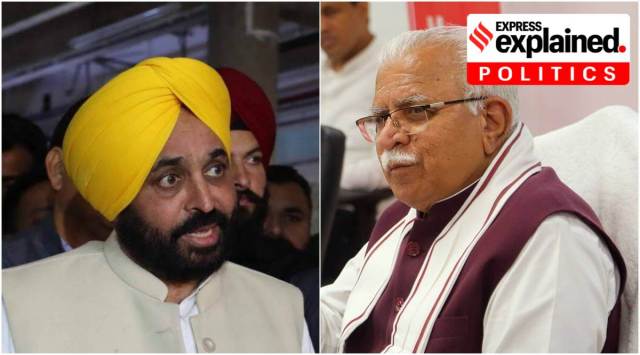 Chief Minister Bhagwant Mann and Manohar Lal Khattar (File Photos)
Chandigarh is not the only bone of contention between the states of Punjab and Haryana, which were carved out of greater Punjab in 1966. The two neighbours have also been battling over their share in the river waters, land boundaries, state Assembly and a joint High Court. This has led to multiple commissions, accords and a web of litigations.
The Indian Express looks back at these efforts to resolve the disputes between the two neighbours.
Shah Commission
On April 23, 1966, the Punjab Boundary Commission, popularly known as “Shah Commission” chaired by Justice JC Shah, was constituted. On May 31, 1966, the Commission recommended that Kharar tehsil (including Chandigarh) shall be part of the Hindi-speaking state, because 71.3 per cent of its population was Hindi-speaking.
Indira Gandhi award
Since November 1, 1966, after reorganization of Punjab and creation of Haryana, both the states had been claiming Chandigarh to be their part. On January 29, 1970 the then prime minister Indira Gandhi announced that Chandigarh will go to Punjab and in lieu of that 105 Hindi-speaking villages, two cities – Abohar and Fazilka – shall be given to Haryana. Besides that, Haryana shall be given Rs. 20 crore for creating a new capital for the state.
White paper by Union government on Punjab’s agitation
In a white released on July 10, 1984 by the Union government, the then home minister Prakash Chandra Sethi’s statement, given in Parliament on February 28, 1984, was mentioned. He had given four options to the Union government to resolve the dispute between two states. 1. Implementation of Indira Gandhi’s January 29, 1970 announcement; 2. Issue of Chandigarh to be handed over to a new commission; 3. Issue of division of Chandigarh between Punjab and Haryana to be sent to another commission; 4. any other option acceptable to both the states. However, Punjab’s then leadership refused to accept either of these four options.

Rajiv-Longowal accord
On July 24, 1985, the then prime minister Rajiv Gandhi signed an accord with Sant Longowal in which it was decided that Chandigarh would be given to Punjab. A few nearby areas of Chandigarh that were Hindi or Punjabi speaking were to be distributed between Haryana and Punjab, accordingly. Sukhna Lake would remain part of Chandigarh and shall go with Chandigarh to Punjab’s share. A commission shall be constituted to identify all such Hindi-speaking areas in Punjab that would go to Haryana. The Rajiv-Longowal accord of June 24 specified that “the principles of contiguity, linguistic affinity with village as the unity, will be the basis…to determine the specific Hindi-speaking areas of Punjab which should go to Haryana in lieu of Chandigarh”.
Mathew Commission
According to Rajiv-Longowal accord, Justice KK Mathew Commission was constituted on August 20, 1985 to identify the Hindi-speaking areas of Punjab to be given to Haryana, which submitted a list of 408 such villages and two cities (Abohar and Fazilka). On January 25, 1986 the Commission concluded that 83 Hindi-speaking villages and Abohar and Fazilka cities could be given to Haryana. But, Muktsar tehsil’s Kandukhera village hampered the contiguity of the Hindi-speaking land-bank that had to be transferred to Haryana.
Venkataramiah Commission
Another Commission was constituted under Justice ES Venkataramiah to identify Hindi-speaking areas of Punjab to be given to Haryana. This Commission in its report to the Union home ministry in June 1986 recommended that in lieu of Chandigarh, 70,000 acres of Punjab land should be given to Haryana and the Government of India should bear the expenses of acquisition of land, development and creation of a new capital city for Haryana. It was also recommended that the Government of India can raise Rs. 200 crore by selling assets in the National Capital Region. The Commission had also identified 45,000 acres of land and recommended that another Commission should be constituted to identify the remaining 25,000 acres.
Desai Commission
On June 20, 1986, another Commission under Justice DS Desai was constituted by the Government of India to demarcate 70,000 acres of Punjab that had to be transferred to Haryana in lieu of Chandigarh. The Haryana government raised another claim of 141 villages adjoining Panchkula and Ghaggar river.
Newsletter | Click to get the day’s best explainers in your inbox
Haryana Vidhan Sabha resolution – March 13, 1997
On March 5, 1997, the Punjab Governor in his address to the Punjab Vidhan Sabha mentioned about transfer of Chandigarh and Punjabi speaking areas in Haryana to Punjab. In response to that, Haryana Vidhan Sabha on March 13, 1997 unanimously passed a resolution whereby the Union government had to be requested to end injustice being meted out to Haryana. It was also passed that Shah Commission’s recommendations be implemented in totality.
Punjab Termination of Agreements Act, 2004
Punjab enacted the Termination of Agreements Act in 2004 nullifying all such interstate treaties, agreements, resolutions between the two states and any orders/ recommendations passed by the Commissions or any Accords. It annulled the Government of India’s 1976 orders, tripartite agreements of Punjab, Haryana, Rajasthan of 1981; Rajiv-Longowal accord and several other recommendations made by multiple Commissions resolving the disputes between the two states. A similar resolution was once again passed by Punjab Vidhan Sabha on December 23, 2014, as well.
Hansi-Butana canal
In 2007, Punjab and Rajasthan moved the Supreme Court against linking of Hansi-Butana canal with Bhakra main line. On August 17, 2007, the Supreme Court issued a stay order on linking of the canal with Bhakra main line. The then Congress government of Haryana did not initiate any steps in the Supreme Court to get this stay order vacated. The incumbent state government of Haryana has started pursuing the matter in the Supreme Court since October 27, 2014 – the date when hearing of this case took place in the Supreme Court. The matter is pending for over seven years and the stay order continues. The final arguments are yet to take place in this case.
Separate High Court
On May 4, 2017, Haryana passed a resolution in the Vidhan Sabha seeking a separate High Court. Under Article 214 of Constitution of India, there is a provision that all the states should have their separate High Court. Newly formed states including Jharkhand, Chhattisgarh and Uttarakhand have got their separate High Courts. Although Haryana has been a separate state for over five decades, it has not got its own High Court. In the current strength of 85 judges in Punjab and Haryana High Court, only 18 judges are from Haryana. Even the filing of litigations in Punjab and Haryana High Court from Haryana is more as compared to Punjab. Earlier too, the Haryana Vidhan Sabha had passed similar resolutions seeking partition of Punjab and Haryana High Court and a separate High Court for Haryana on March 14, 2002 and December 15, 2005. Chief Minister Manohar Lal Khattar had also raised this issue in a conference of chief ministers and Chief Justices, on April 24, 2016. Khattar has also written to the Prime Minister seeking a separate High Court for Haryana, on priority.
Separate Vidhan Sabha complex
The total area of Vidhan Sabha complex given to Haryana is 24,6430 square feet. However, Haryana claims that 20 rooms in the joint Vidhan Sabha complex shared by Punjab and Haryana, were supposed to be given to it. Haryana had been seeking land from the Government of India for constructing a separate Vidhan Sabha complex for the state. On November 3, 2020, Haryana Vidhan Sabha passed a resolution and requested the Punjab Vidhan Sabha Speaker that the 20 rooms should be vacated and transferred to Haryana.