Latest Comment
Post Comment
Read Comments
 8 min read


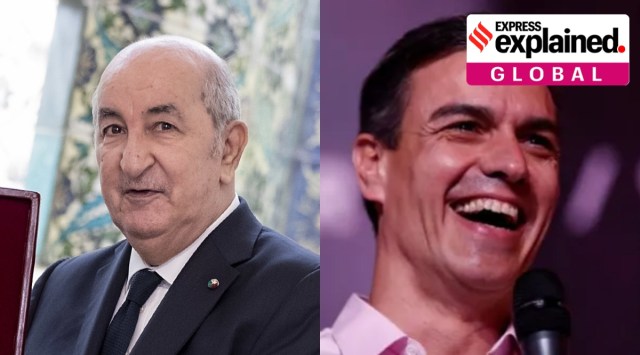 Algerian president Abdelmadjid Tebboune (L), Spain's Prime Minister Pedro Sanchez. (Photo: wikimedia.org, File)
Written by Manya Sheil
On June 8, Algeria announced that it was immediately suspending its 20-year-old treaty of “friendship, good neighbourliness, and co-operation” with Spain. The blow to the ties, which have proved mutually beneficial for both countries, came after Spain decided to shift its position on the Western Sahara dispute.
It was in 2002 that Madrid and Algiers had signed a deal to promote dialogue and co-operation on political, economic, financial, education and defence issues.
The dispute started with colonisation of the region by Spain in 1884.
When Spain announced its withdrawal from Western Sahara in 1975, the region descended into a conflict between Mauritania, Morocco and the Polisario Front – with all three trying to control the region.
The Polisario Front declared the establishment of the Sahrawi Arab Democratic Republic (SADR) in Western Sahara on the very day Spain left.
However, the SADR did not get Western recognition despite going on to become a member of the African Union.
The matter then came up before the International Court of Justice in 1975 itself, and the court decided neither Morocco nor Mauritania could claim sovereignty over Western Sahara. The ICJ called for decolonization of the region. Notwithstanding the ICJ’s decision, the Moroccan Sultan began the “Green March” towards Western Sahara causing an influx of thousands of Moroccans in the region.
The Polisario Front kept fighting both Morocco and Mauritania. The Front signed a ceasefire with Mauritania in 1979. The fighting with Morocco continued and finally ended when both Morocco and the Polisario Front agreed to a UN-proposed peace deal.
Post this 1991 Agreement, Morocco controls about 80 per cent of the Western Sahara, with the Polisario Front-led SADR operating primarily from the eastern flank of the region and from refugee camps in Algeria.
In 2007, the Moroccan government proposed limited autonomy under which the Sahrawis would be free to run their government, but under the shadow of overarching Moroccan sovereignty. The Polisario Front rejected it arguing that Morocco would continue to control key areas related to phosphate reserves and fisheries, defence, and foreign affairs.
The Front continues to push for complete independence with support from Algeria.
Spain’s official position for years has been to back a UN-sponsored referendum to settle the region’s decolonization.
A recent statement by Morocco’s royal palace, however, said: “Spain considers the autonomy initiative presented by Morocco in 2007 as the basis, the most serious, realistic and credible, for resolving the dispute.”
The Spanish Foreign Ministry confirmed the Moroccan announcement.
In the run up to this, the relationship between the two countries had hit a historic low after it was revealed that Brahim Ghali, the leader of the Polisario Front, was admitted to a hospital in Spain for Covid-19 treatment in 2021. He had after a month’s treatment moved to Algeria to continue his recovery.
But to pressurise Spain amid this diplomatic row, Morocco had reduced border controls to the Spanish city of Ceuta on the coast of North Africa causing about 10,000 immigrants to enter the country.
The shift in Spain’s stance is a likely bid to end for good its long-running dispute with Morocco.
Given Spain’s standing as a former colonial power, the country has always been expected to maintain a semblance of neutrality on the matter.
However, Spain siding with Morocco publicly and expressing support for limited autonomy under Moroccan sovereignty has disrupted the delicate balance of power in the region.
Algerian President Abdelmadjid Tebboune has stated that Spain’s repositioning was “unjustifiable” and was “contributing directly to the degradation of the situation”.
Algeria has been a committed supporter of the Polisario Front, after it recognised the Sahrawi Arab Democratic Republic in 1976. Over 1.7 lakh Sahrawi refugees live in camps in Algeria’s Tindouf province after fleeing Moroccan violence.
What next?
Spain’s gas supply might be in jeopardy, given Algeria has been the country’s primary supplier of the same.
According to Al Jazeera, the current contract between Algeria and Spain regarding trade of natural gas supplies is long-term, but with the resource being pegged at a price far lower than the market price.
Given Spain’s inclination to help Morocco in boosting its gas supplies, Algerian authorities have threatened the Spanish government stating if gas from the country were to be diverted to a third destination, they would be suspended immediately.
On June 9, Algeria also decided to suspend foreign trade of goods and services with Spain, affecting all forms of trade apart from those pertaining to gas supplies.
Spain’s exports to Algeria include meat, metals and industrial chemicals. There are fears that the deadlock might cause a spike in inflation in Spain. The European Union has urged the Algerian government to “reverse their decision” and revoke the suspension of the cooperation treaty with Spain.
Responding to the above article, the Press Department of the Embassy of the Kingdom of Morocco has written:
In the context of the right of reply, we would like to state that the Moroccan Sahara issue is settled historically, socially and legally. There are hundreds of documents that serve as evidence about the legitimacy of the allegiance of the tribes of the Sahara to the Moroccan Monarchy, which was transmitted by the advisory opinion of the International Court of Justice in 1975.
The article claims that the Moroccan Sahara dispute started “with colonisation of the region by Spain in 1884”. In fact, this region, which has always belonged to the Kingdom of Morocco, was taken over in the 19th century by the Spanish colonial power. After getting independence, the Kingdom of Morocco started to complete its territorial integrity from Spain gradually and through negotiated international agreements. The Madrid Accords of 1975 marked the end of Spanish presence in the Moroccan Sahara region, and to the reintegration of all Saharan provinces into Morocco as of 1979.
The article alleges that a so-called “Polisario Front declared the establishment of the Sahrawi Arab Democratic Republic (SADR) in Western Sahara on the very day Spain left”. The truth is that the Polisario did not exist during the Spanish colonial period and was never heard of before 1973. Morocco was the only country to claim the territory, at the international level (UN) as far back as early 1960s.
At the international level, the Polisario has never been recognized as a liberation movement, let alone being acknowledged as the only legitimate representative of the Sahrawis. Neither the United Nations nor the Arab League recognizes the artificial Sahrawi Arab Democratic Republic. India too, withdraw its recognition to this entity as early as 2000.
The article claims the existence of “refugee camps”, and says “over 1.7 lakh Sahrawi refugees live in camps in Tindouf, South of Algeria, after fleeing Moroccan violence”. The truth is that only a very small portion of the Sahrawi population lives, against their will, in the camps in Tindouf without any rights. The WFP used to give assistance and aid to this population on the basis of an estimation of 90,000, while Morocco believes that the population in the camps wouldn’t exceed 40,000. Algeria and Polisario have always refused to conduct a census despite numerous calls by the UNSC.
The article speaks of so-called Moroccan “control of key areas related to phosphate reserves and fisheries” in the region; however, national natural resources management happens according to the requirements of development and the needs of the population for jobs.
The article claims that the Kingdom reduced border controls to put pressure on Spain. The truth is that in the fight against illegal migration, Morocco’s record is distinguished and well-known. In fact, the Kingdom is a key responsible actor that aborts most attempts at illegal immigration to Europe.