Journalism of Courage



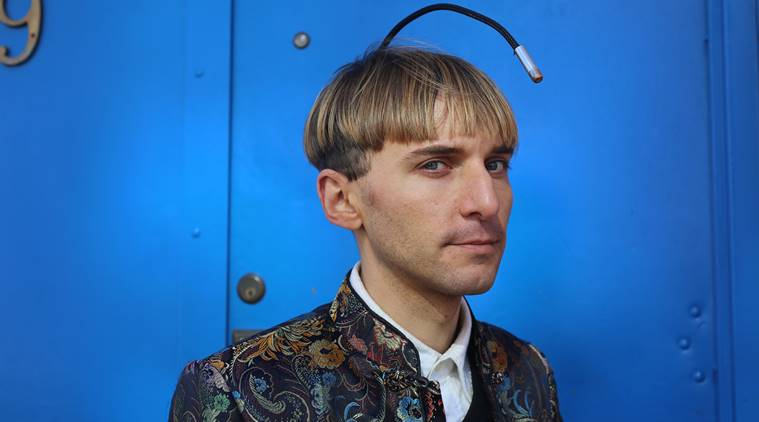 What’s your colour? Neil Harbisson. (Source: Lars Norgaard)
The short film Hearing Colors, by New York-based director Greg Brunkalla, shows Neil Harbisson in the centre of Times Square, New York City. Shot entirely in black and white, one can’t tell the colour of the sky or any billboard. But Harbisson can, and in his world, it’s one of the most musical places. “Colour is an energy that bounces all over the place that people can see, and they have names for it,” says Harbisson, who was in Delhi last week for the India Design ID 2018 symposium. For someone who can now hear colour and paint sounds, Harbisson’s world was quite bleak growing up — he was born with a rare form of colour blindness that made him see the world only in greys. At 21, an antenna was implanted in Harbisson’s skull to help him decode the world better. The 360-degree antenna, which he says was inspired by nature, has colour sensors that send light frequencies to a chip at the back of his head. This chip transposes colour into sound waves, which he ‘hears’ through bone conduction.
Harbisson is almost evangelical in his many presentations across over the world, calling himself a cyborg activist. “For thousands of years, human beings have been changing and damaging the planet. We want people to realise that if you design yourself, you can better integrate with other species. We want bio-ethical communities to accept these kinds of trans-species surgeries,” says the 33-year-old.
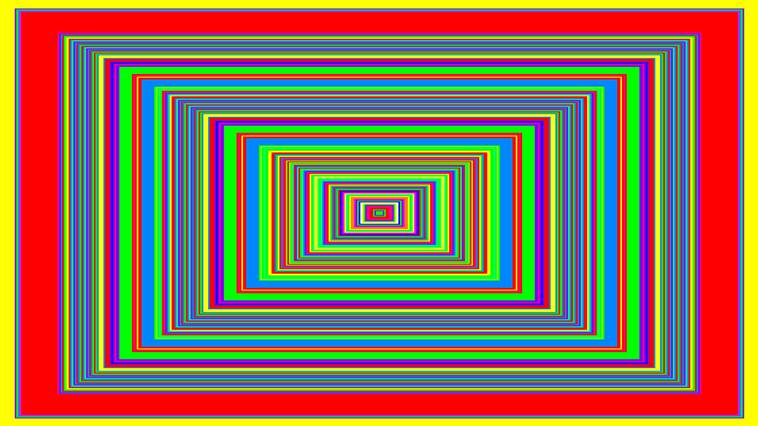 how Harbisson ‘hears’ Mozart’s Queen of the Night. (Source: Lars Norgaard)
It took many letters and arguments to the UK government for them to recognise Harbisson as a cyborg: a living being who uses basic or cybernetic parts to enhance or replace physical parts. Talking to Harbisson takes some getting used to as you see his antenna as a fixed body part. “We are surrounded by natural elements that our senses cannot receive. When you add an artificial sensory element, you connect with other species that have these senses. I can recognise the colour wheel and also perceive infra-red and ultra-violet rays. So, if I see a cat looking at a wall, and there is infra-red, I can see the rays. If I see bees going to a specific flower, I can understand bees in a way that I didn’t before.”
His blonde bowl hairstyle sits on his angular face with a sharpness that’s matched by his choice of clothes. “I now wear colours that sound good rather than look good,” says Harbisson. If he were to attend a funeral, he says, he would dress in colours of purple, orange and turquoise, which are quieter colours in his vocabulary. “To me, the colour of peace is red since it has a low frequency of light. It’s the most innocent colour of all. Green is neutral because it’s in the middle of the spectrum, so I would choose it for doors. It’s like a tuning fork — it tunes your entry and exit. But violet has the highest frequency, so it is dangerous. If there was a society of hearing colour, it would change the way we design things; stop signs at traffic lights would be violet,” he says, alluding to Isaac Newton’s colour theory. Harbisson connotes cities with colours, and says that Delhi to him is lime and brown — politely refraining from mentioning that lime comes from all the honking he hears.
 and His artwork, City Colours. (Source: Lars Norgaard)
Harbisson has taken his sense of colour to concerts and sound portraits, where he uses his antenna to capture the sound of a person’s hair or the colour of his lips. As part of his talk at the India Design symposium, Harbisson showed images of him scanning people’s faces. “Judy Dench sounds very quiet, her hair is silent, while Woody Allen’s is very soft, like an old painting,” he says. What shocked him, though, at the beginning of his research, was how people are neither black nor white. “Nobody is black or white, we all are different shades of orange,” he says. He reveals he can hear paintings too, and can translate music into colours as well. “I see the future as the internet of the senses. I tell people I don’t use technology, I am technology.”
With his collaborator and childhood friend, Moon Ribas, Harbisson established the Cyborg Foundation in 2010, which helps humans become cyborgs — with the help of surgeries, defend their rights, and promote cyborg art. Ribas has a seismic sensor implanted in her elbow that allows her to feel earthquakes and moonquakes through vibrations, which she then translates into dance and music. The Transpecies Society, which they co-founded last year, “gives voice to people with non-human identities and defends the freedom of self-design”.
“Our aim is not to become machines. People watch sci-fi movies and confuse us with robots. Some others think that we are going against god and humanity. But we see ourselves as part of the evolution process — if we were first bacteria and then lived on trees, this is the renaissance of our species. We are collaborating with god, in that we are not modifying any of our senses, we want to remain as we are — but we are using technology to connect with nature in a deeper way,” says Harbisson.

 6 min read