3 min read
Stay updated with the latest - Click here to follow us on Instagram
© IE Online Media Services Pvt Ltd



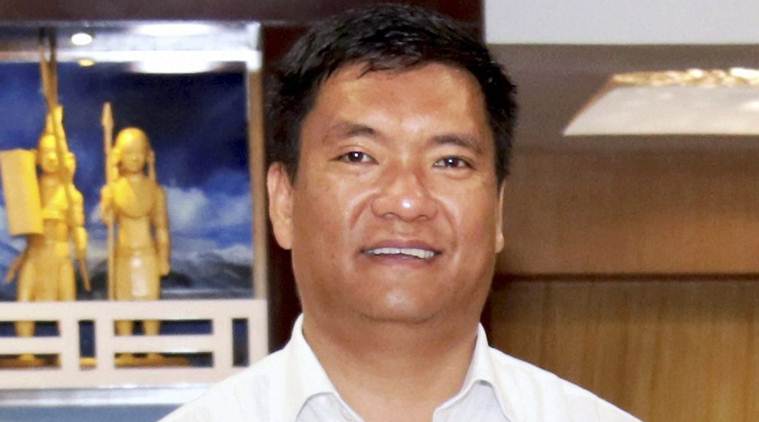 Arunachal Pradesh Chief Minister Pema Khandu (File Photo)
Arunachal Pradesh Chief Minister Pema Khandu on Monday reiterated the concerns of the local people on the vexed issue of granting citizenship to Chakma and Hajong refugees in the state, and told the Centre that they were not ready to accept any infringement on the Constitutional protection bestowed on them.
“As mentioned by me in our meeting recently, I reiterate that the people of my state are not ready to accept any infringement on the Constitutional protection bestowed on the tribals of Arunachal Pradesh and want to ensure that the ethnic composition and the special rights enjoyed by the tribes of my state are safeguarded at all cost,” Khandu, in the letter sent to Union home minister Rajnath Singh said.
Khandu, who shot off his letter to the Union home minister one day ahead of a statewide bandh called by the All Arunachal Pradesh Students’ Union (AAPSU), also described the matter as one “of deep emotional concern”. He also solicited the Union home minister’s support in protecting the tribal rights and securing the sanctity of the Inner Line Permit (ILP) in Arunachal Pradesh.
The Union home ministry had last week cleared the decks for granting citisenship to the Chakma and Hajong refugees of East Pakistan origin on the basis of a Supreme Court directive. He also pointed out that Arunachal Pradesh had its own unique history and was governed by a special Act namely the Bengal Eastern Frontier Regulation, 1873, which prescribes a line to be called the Inner Line. “Section 2 of this Regulation prohibits all citizens of India or any class of such citizens from going beyond the Inner Line without a pass issued under the hand and seal of the CEO of such district or such officer authorized with such function,” the chief minister said.
Quoting from Section 7 of the Bengal Eastern Frontier Regulation, Khandu also said that no person other than the natives of the state could acquire land in Arunachal Pradesh. “It shall not be lawful for any person, not being a native of the district comprised in the preamble of this regulation, to acquire any interest in land or the product of land beyond the said Inner Line….,” the chief minister’s letter quoting Section 7 said.
While several thousand Chakma and Hajong tribals fled erstwhile East Pakistan in the wake of religious persecution and eviction in the name of construction of the Kaptai dam on the Karnaphuli river in the Chittagong Hill Tracts, altogether 14,888 Chakma persons of 2,748 families were settled in then NEFA (now Arunachal Pradesh) during 1964-69. While their number has grown to more than 60,000, they have been living as refugees with only a handful of them getting voting rights.
The consensus in Arunachal Pradesh is that the Chakmas were settled in the state when there was no provision of an elected government there, granting them citizenship would seriously disturb the demographic composition and reduce most of the indigenous tribal communities into minorities.
Stay updated with the latest - Click here to follow us on Instagram