Journalism of Courage



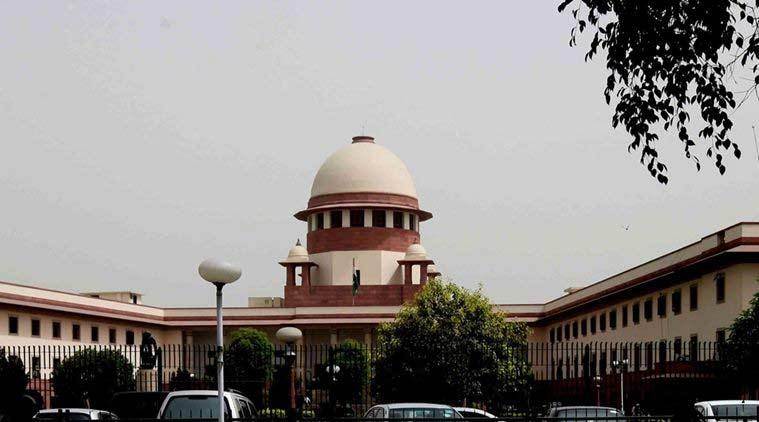 Disqualification of lawmakers: SC asks Parliament to rethink Speaker’s powers, suggests independent body
THE SUPREME Court on Tuesday asked Parliament to “have a rethink on whether disqualification petitions ought to be entrusted to a Speaker as a quasi-judicial authority when such Speaker continues to belong to a political party either de jure or de facto”.
“Parliament may seriously consider amending the Constitution to substitute the Speaker of the Lok Sabha and Legislative Assemblies as arbiter of disputes concerning disqualification which arise under the Tenth Schedule with a permanent tribunal, headed by a retired Supreme Court Judge or a retired Chief Justice of a High Court or some other outside independent mechanism, to ensure that such disputes are decided both swiftly and impartially, thus giving real teeth to the provisions in the Tenth Schedule, which are so vital in the proper functioning of our democracy,” said a bench of Justices R F Nariman, Aniruddha Bose and V Ramasubramanian.
The bench was ruling on a petition on the March 2017 Manipur Assembly elections. The plea, first filed in the Manipur High Court, had sought a direction to the Assembly Speaker to take a decision, within a reasonable time period, on a petition filed by MLA K Meghachandra, seeking disqualification of Th Shyamkumar, who had contested on a Congress ticket but later moved to the BJP camp and became a state minister.
Asking the Speaker to take a decision within four weeks, the Supreme Court said: “In case no decision is forthcoming even after a period of four weeks, it will be open to any party to the proceedings to apply to this Court for further directions/ reliefs.”
Earlier, the HC had said that as the issue of whether a Speaker can be directed by courts to decide a disqualification petition within a certain time frame was pending before a five-judge bench of the Supreme Court, it could not pass any order in the matter.
Appearing for the appellant, Senior Advocate Kapil Sibal urged the Supreme Court to issue a writ of quo warranto against Shyamkumar.
Opposing Sibal’s contention, Additional Solicitor General Madhavi Divan said the court should await the decision of the five-judge bench.
Writing for the Bench, Justice Nariman said: “We find that this very issue was addressed by a five judge bench judgment in Rajendra Singh Rana vs. Swami Prasad Maurya case… stating that a failure to exercise jurisdiction vested in a Speaker cannot be covered by the shield contained in paragraph 6 of the Tenth Schedule, and that when a Speaker refrains from deciding a petition within a reasonable time, there was clearly an error which attracted jurisdiction of the High Court in exercise of the power of judicial review”.
The court said “the Speaker, in acting as a Tribunal under the Tenth Schedule, is bound to decide disqualification petitions within a reasonable period. What is reasonable will depend on the facts of each case, but absent exceptional circumstances for which there is good reason, a period of three months from the date on which the petition is filed is the outer limit within which disqualification petitions filed before the Speaker must be decided if the constitutional objective of disqualifying persons who have infracted the Tenth Schedule is to be adhered to. This period has been fixed keeping in mind the fact that ordinarily, the life of the Lok Sabha and the Legislative Assembly of the States is five years and the fact that persons who have incurred such disqualification do not deserve to be MPs/ MLAs even for a single day…”
The anti-defection law, referred to as the Tenth Schedule, was added to the Constitution by way of the Fifty Second (Amendment) Act, 1985. The law was to check the trend of defection. The statement of object and reasons of the Amendment Act said, “The evil of political defections has been a matter of national concern. If it is not combated, it is likely to undermine the very foundations of our democracy and the principles which sustain it. With this object, an assurance was given in the Address by the President to Parliament that the Government intended to introduce in the current session of Parliament an anti-defection Bill. This Bill is meant for outlawing defection and fulfilling the above assurance”.
The SC, however, said it could not accede to Sibal’s submission that it should issue writ of quo warranto quashing Shyamk-umar’s appointment. It agreed with Divan that a disqualification under the Tenth Schedule must first be decided by the exclusive authority, in this case, the Manipur Assembly Speaker.
“It is also not possible to accede to the argument of Shri Sibal that the disqualification petition be decided by this Court in these appeals, given the inaction of the Speaker. It cannot be said that the facts in the present case are similar to the facts in Rajinder Singh Rana… In the present case, the life of the Legislative Assembly comes to an end only in March 2022, unlike in Rajinder Singh Rana… where, but for this Court deciding the disqualification petition in effect, no relief could have been given to the petitioner in that case as the life of the Legislative Assembly was about to come to an end,” said the court.

 5 min read