Journalism of Courage



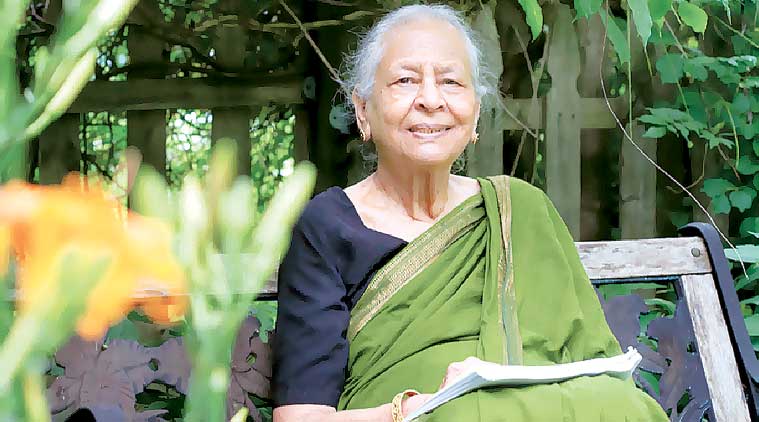 Rukmini Srinivas
In the 1950s, Rukmini Srinivas was a young bride in Berkeley, US, living with her husband M.N. Srinivas, the legendary sociologist known for his work on caste. Unlike most Indians, she had not packed spices from home, even if she had brought along a steel coffee filter. The coriander seeds, tamarind pulp, bay leaves and saffron she found at Armenian and Greek stores in San Francisco. But how could an electric blender do the work of a stone grinder? That dilemma ended when a friend took her to the Berkeley University’s anthropology department museum, and said she could borrow any of the cooking equipment of Native American tribes. She settled on a metate, a a flat-stone grinder used to grind corn. “Nowadays in Boston, I use the granite mortar and pestle that Mexicans use for making guacamole. My daughters are still hopeful that I’ll start using the food processor some day,” writes Srinivas in Tiffin, a memoir-cum-cookbook brought out by Rupa.
When her two daughters were pursuing higher studies in the US, they looked forward to her emails with easy-to-prepare recipes, accompanied by narratives of people and places associated with them. It was on their insistence that she wrote the book. “They urged me to share the stories I had told them over two decades with a wider audience. It’s an attempt to capture the heritage of domestic vegetarian Indian cooking as well as my own family history,” says Srinivas in an email interview. She is now 87 years old and lives in Boston.
Tiffin borrows its title from the colonial-era term for light snacks served at breakfast or late afternoon tea, particularly in south India, rice flour being the primary ingredient for many of the preparations. Srinivas’s meticulously constructed book is a time- travelling capsule, packed with pictures, illustrations, recipes and, most importantly, nostalgia.
Born to a father who was employed with the military accounts department in the Indian Armed Forces, Srinivas was introduced to a variety of flavours early on, as she travelled extensively to Bangalore, Pune, Madras and Jabalpur. She got her first lessons in south Indian cooking in a village in Tanjore, helping her uncle churn out masala vadais, which years later, her American friends would enjoy with glasses of margaritas.
While she recounts with ease the delicious European food she sampled in the Southern Command canteen office in Pune where her father worked in the 1930s, Srinivas confesses that food did not interest her much at the time. “I was thin and would frequently fall asleep without eating. I enjoyed cooking only when I visited my doctor uncle in Tanjore, and we made tiffin together,” she says.
While studying for a Bachelor of Arts (geography) degree at Queen Mary college in Madras, she found the hostel food insipid and jumped at the suggestion to volunteer on the mess committee. She would accompany the head cook to the wholesale market, to buy fruits and vegetables and also organised a mobile canteen to serve tiffin in the evening. She recounts that story in the book, with a recipe of her favourite canteen dish, the crunchy Mangalore bondas.
“In writing about finding myself different from others around me, I ended up revealing a social history of time and place,” she says. Srinivas had grown up in Pune, a fairly liberal city, and she writes about how she found Madras conservative. People would ask her if she was Christian because she wore dresses. Eventually, she gave them up and switched to saris. And on top of that, she fell in love. He was a professor at the University of Oxford visiting Madras while she was teaching at Queen Mary college when they met. She married him in 1955.
A year after the wedding, the couple moved to Berkeley where her husband was a Rockfeller fellow in the department of anthropology. Aboard a steamliner to the US, she faced difficulties acquiring vegetarian food — even soup was made with chicken broth. Once in Berkeley, eating out became challenging as, “vegetarianism was not understood even in the bigger cities of the USA”. On her first Diwali there, she had treated neighbours to Mysore pak, vegetable bajjis and rice payasam. “I discovered that I enjoyed cooking and when friends loved my food and asked for recipes, it gave me confidence,” she says.
She struck a friendship with RK Narayan, whom she fondly called Kunjappa, as he joined Srinivas and her husband for late afternoon tiffin on weekends. Also a Rockfeller fellow, Narayan’s favourite dishes were curd rice and ulundu vadai — spicy, deep-fried blackbean doughnuts. “Sharing food is a delight and that’s how I remember it, aesthetically, the smell, taste, colour and ‘feel’ of vegetables,” she says.
In the ’60s, as neighbours and friends in the US were introduced to Srinivas’s style of cooking, they asked her to teach their teenaged children how to fix simple, vegetarian meals. Soon, six students became 16, and Srinivas also started vegetarian classes at the local farmer’s market. Today, she has her own show on the Arlington cable network and holds classes at the Cambridge Centre for Adult Education. “Expert chefs trained in other cuisines have enrolled in my classes. What was a fringe movement in 1964 with vegetarian cooking has now gone mainstream. There’s a wide choice of Indian vegetables, dals, spice blends, papads, pickles,grated fresh coconut for chutneys, available in Boston,” she says.
Now writing her next book, Recipes and Remedies from an Indian Kitchen, Srinivas’s relationship with food has grown deeper. “We grow vegetables in our garden in Boston and I get seedlings from farms. In fact, I’m planning to visit a nearby community farm with my son-in-law soon.”
Pesarattu, Green Gram (Moong Bean) Dosai
 Pesarattu, Green Gram (Moong Bean) Dosai
This dish is from the state of Andhra. With its distinctive colour and taste, it needs no fermentation. Tastes good with tamarind chutney
Ingredients to make 4–6 Pesarattu
1 cup whole green gram
2 tablespoons rice
3 green chillies, minced and divided
1-inch piece fresh ginger, grated
1 teaspoon cumin seeds, dry roasted and coarsely crushed
1 medium sized onion, finely chopped or thinly sliced
½ cup oil
½ cup ghee
salt to taste
¼ cup chopped fresh coriander leaves
Method
* Wash and rinse green gram and rice twice. Drain. Soak in water for six hours. Drain.
* Grind in a blender to a fine pancake batter adding enough water. Add half the quantity of chillies and all the ginger, and pulse twice. Transfer to a bowl.
* Add salt and cumin. Stir and set aside for 10 minutes.
* Heat a cast iron griddle on medium low heat. Grease with teaspoon oil. Pour cup batter, and spread evenly to a thin disc with the underside of a ladle, or cup.
* Drizzle one teaspoon ghee on top. Scatter a few pieces of green chillies, onions and some coriander. Cover with a lid and cook for one minute. Remove lid, flip over and cook the pesarattu, uncovered, for one minute.
* Lift and serve hot with ginger-tamarind chutney.
The story appeared in print with the headline Making Vadai in Berkeley

 7 min read