
Opinion Clamour for death penalty for R G Kar convict is self-defeating
While it satisfies those who demand instant justice, it diverts our attention from the real task at hand — resisting the normalisation of a culture that promotes brute and toxic masculinity and the objectification of a woman.
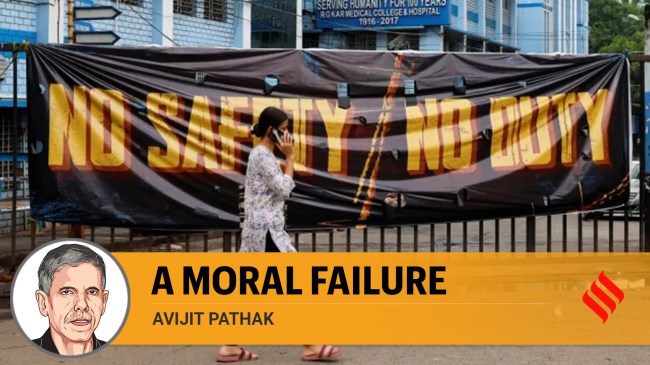 While death penalty satisfies those who demand instant justice, it diverts our attention from the real task at hand — resisting the normalisation of a culture that promotes brute and toxic masculinity and the objectification of a woman.



A Kolkata court sentenced Sanjay Roy to life imprisonment after he was convicted of the rape and murder of a 31-year-old doctor at the state-run R G Kar Medical College and Hospital. The entire country — particularly, West Bengal — witnessed massive public outrage after this ghastly incident in August 2024. It will not be wrong to say that almost everybody — from Chief Minister Mamata Banerjee to all those young doctors, students, activists and celebrities demanding “justice” on the streets of Kolkata — was expecting nothing less than capital punishment for Roy. A “milder” punishment like life imprisonment seems to have disappointed them. From noisy debates on Bengali news channels to the addas in local tea shops, you hear a passionate plea for the death penalty. We are told the West Bengal government will approach the Kolkata High Court soon, and seek capital punishment for Roy.
Amid this mass support for the death penalty, it is not easy to articulate even the slightest ambiguity towards it. With deep empathy, I try to make sense of the mental state of the bereaved parents of the doctor, and even those who experience the violence, be it physical or psychological, of brute masculinity at home, work or in public. I understand that it is not easy for them to think of any other punishment apart from the death penalty. Yet, I cannot bring myself to approve of the death penalty, even if Roy’s crime falls in the category of the “rarest of rare”.

There are three reasons I oppose the very idea of the death penalty. My first argument is moral and existential. Capital punishment is an act of violence, even if it is legitimised by the state and its law and order machinery. And one form of violence can by no means be a solution to other forms of violence. I agree with Amnesty International when it unambiguously states that capital punishment is the most “inhumane and degrading punishment” — almost like committing the same violence the state otherwise condemns. Moreover, every act of capital punishment reveals our collective failure — our inability to work with the rapist or the murderer or the terrorist, understand his inner turmoil, heal his wounded self through a mix of isolation, careful observation, education, counselling, and life-affirming labour. In fact, like rape and murder, every act of capital punishment reveals the moral failure of our civilisation.
My second argument is factual. As many studies have shown, the death penalty does not deter crimes any more effectively than other punishments. In fact, crime figures in countries like Denmark, Norway and the Netherlands, which have abolished the death penalty, have not risen. However, in India, as the Annual Statistics Report 2023 indicates, “at the end of 2023, 561 prisoners were living under a sentence of death”. But there are more than 31,000 reported rape cases every year in India.
Moreover, the death penalty is disproportionately applied to people who are poor and marginalised. As A P Shah, a former chief justice of the Delhi High Court, said in an interview with Amnesty, “the poor and the downtrodden get the death penalty, and one hardly finds a rich or affluent person going to the gallows”.
And finally, my third argument is that while it satisfies those who demand instant justice, it diverts our attention from the real task at hand — resisting the normalisation of a culture that promotes brute and toxic masculinity and the objectification of a woman. In a society where on average there are 86 incidents of rape every day, we need to go beyond the instant fulfilment for “justice” through capital punishment, and instead, work rigorously in the domain of culture, socialisation and education. Only then will it be possible for us to create a society in which young boys refuse to dance to repulsive “pop” songs like Main hoon balatkari on the streets, acquire the moral courage to boycott a misogynic film like Animal (2023), and realise the redemptive power of dignity and symmetry in a relationship between a woman and a man.
The writer taught at JNU

 Share
Share


