

Journalism of Courage

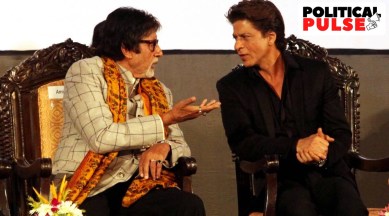
Two of the most loved and successful actors in the history of Indian cinema, Amitabh Bachchan and Shah Rukh Khan recently took the proverbial better-late-than-never step to highlight censorship and trolling of the entertainment industry.


The speeches of Bachchan and Khan bear significance since Hindi film biggies in the recent past have tended to remain silent in the face of political attacks. Bachchan has remained mum over the years even though the industry, which is repeatedly hailed as India’s “soft power” by the government, has been subjected to a series of vilifications under some pretext or the other. In recent years, Khan, known for his wit and caustic humour, has also stayed away from making any public statements in spite of being targeted on multiple occasions for his films and his religion.

Whenever Aamir Khan and Shah Rukh Khan have spoken about the way intolerance has gained social currency, they have faced a backlash. The film industry’s inability to come together – even though it is aware that these statements merely reflected their concerns over polarisation and societal divisions – has emboldened those behind the trolling. Though the government forces trying to control the industry for their benefit is not a new phenomenon, after the BJP government came to power in 2014, extra attention is paid to censoring films and shows.

In the past few years, the industry has also found itself the target of multiple agencies — the CBI, Enforcement Directorate, and Narcotics Control Bureau (NCB). Though the BJP has claimed it has no interest in “ruling Bollywood”, as the Hindi film industry is popularly known, the Rashtriya Swayamsevak Sangh (RSS) has admitted an “interest” in the industry. “Whatever the industry makes, they make for the people of India, and the RSS is interested in whatever is being done for the people of India. But we do not have any intention to control it,” RSS leader Pramod Bajpat told The Indian Express in 2020.
The industry is more divided than before while public sentiments are being whipped up against some of the popular stars by the media and social media. As a result, film personalities as well as their works are constantly scrutinised.
Bachchan’s concerns reflect ground realities. Referring to the history of censorship, he said, “Even now, ladies and gentlemen – and I am sure my colleagues on stage will agree – questions are being raised on civil liberties and freedom of expression.” Even though many on social media unsuccessfully tried to give his statement a different spin and projected it as a dig at West Bengal Chief Minister Mamata Banerjee, it was clear that the veteran superstar was talking about creative freedom being stifled.
Referring to Ganashatru, one of Satyajit Ray’s seminal works, he said, “In this chamber drama, about a jaundice epidemic caused by water contamination that is suppressed by both the state and the local temple, Dr Asok Gupta (the protagonist) becomes the enemy of the people, fighting for justice.”
Though there are instances over the decades of top-bracket celebrities — from Kishore Kumar, Dev Anand, and Shabana Azmi to Anurag Kashyap and Prakash Raj — and other film personalities raising their voice against the establishment, it has become a rarity today. Most celebrities have adopted survival strategies such as maintaining a low-key profile, avoiding any confrontations and, generally, toeing the line. And, those like Richa Chadha, Swara Bhaskar, and Hansal Mehta, who are vocal against bigotry, are at the receiving end of abuse on social media.
So, it makes sense when Khan talked about “negativity” increasing social media consumption and how “such pursuits often enclose collective narrative and makes it more divisive and destructive”. The actor also offered a solution. He said the need of the hour was to build a better world for future generations by “using the power of cinema as a vehicle for people of different cultures, colours, castes, and religions to better understand each other”.
The question remains, will Indian filmmakers take up this challenge? Using the cinematic language, they can offer a narrative that counters the hate agenda and attacks.
The statements made by Bachchan and Khan can be construed as pushback from an industry that has been mostly suffering silently for a long time. For now, it appears to be a small step taken by the two industry stalwarts towards asserting the power of cinema. What Khan and Bachchan have done, personalities in Hollywood and Europe, and countries such as Iran have done for a long time. It remains to be seen if the industry can unite to transform it into a big leap against its detractors.


