Journalism of Courage



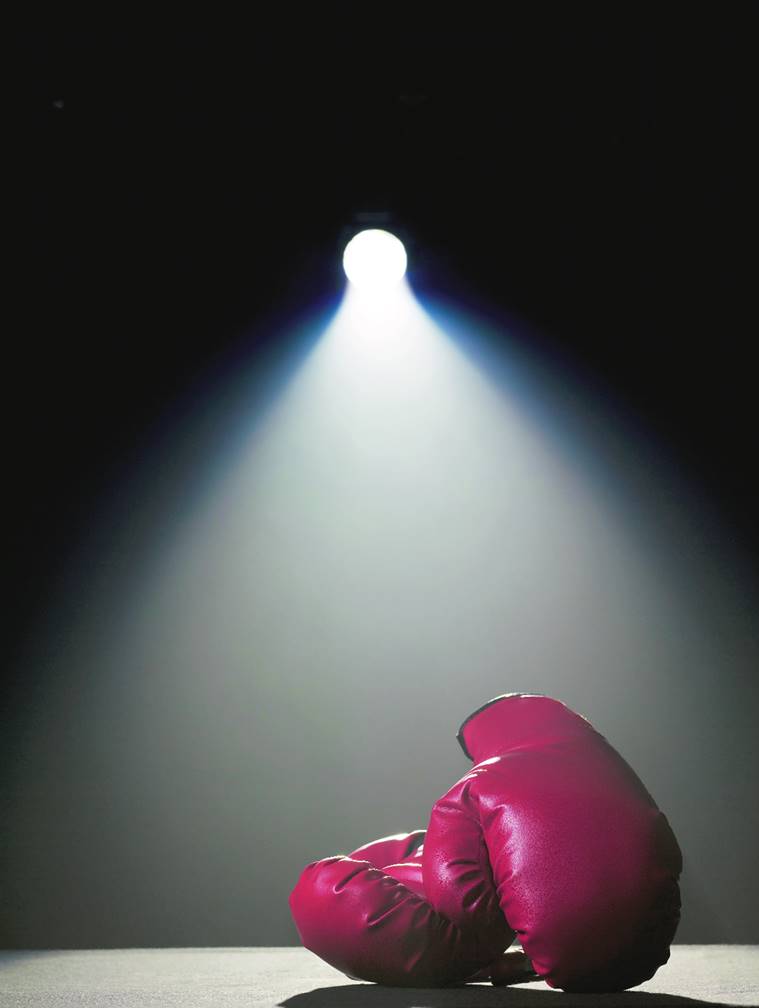 A rejigged selection policy and a new coaching philosophy powers the Indian boxing squad.
Being an unwanted guest at the national camps in Delhi and Patiala was not for the easily shamed, with acquaintances who couldn’t really turn you away but didn’t particularly want to entertain you. The coaches would apologetically inform you to take the requisite clearance from the federation, a chore made nigh impossible by the administrators’ tendency to not respond. The boxers would do their best impression of a deer caught in the headlights, before shuffling away. Repeated queries regarding the secrecy eventually drew a retort: “We don’t want a Limba Ram situation.”
Limba Ram’s is a case study often cited as a cautionary tale against hyping medal prospects. The archer tied the world record in 1992 to send the back pages into overdrive. Touted as India’s brightest hope at the Barcelona Olympics later that year, the 20-year-old missed a medal by a solitary point.
The upcoming Commonwealth Games are no Olympics. They aren’t even the biggest multi-sport event of the year. But for the hitherto efficient — if a tad too image-conscious — Boxing Federation of India, and more importantly, several first-timers including the foreign coaches, Gold Coast is the first proving ground. And with each success and failure magnified manifold in today’s media landscape, one can’t blame Indian boxing for trying to keep a low profile.
“It has been a conscious decision on our part to limit the interactions with the coaches, the support staff… Most importantly the boxers,” says an official. “These kids are from small towns, going to their first big event. If the media starts to hype them, they might sit back and worry, ‘Am I even worth such coverage? Am I talented enough?’ Then they fail. We have seen this happen many times before.”
Men’s foreign coach Santiago Nieva offers a more pragmatic assessment.
“Things can be a little more black and white for journalists. But at the end of the day, if you’re an athlete or a coach, this is what you work for. You should be able to talk to the press and still be focused when they’re in the ring,” Nieva told The Indian Express at the contingent’s send-off in the Capital. “It also differs from boxer to boxer. Some will inevitably feel the pressure and will benefit from not speaking to the press. Other boxers enjoy the hype, the attention.”
***
 Krishan gives his endorsement to the federation’s new point-based selection policy. (Source: Express file)
Vikas Krishan falls firmly in the latter camp. The first thing the straight-shooting 26-year-old does is lower the stakes considerably.
“Looking at how India has performed at the previous editions, competition kuch itna zyaada hone waala hai nahi,” says Krishan, a former Youth Olympic champion, world championship medallist and Asian Games gold medallist. “I’m expecting at least England to field good boxers. You might see a couple of good kids from Canada and Australia.”
Four years ago, a cut above the left eye forced Krishan out of an appetising CWG trials clash with Vijender Singh, who went on to take the 75kg silver in Glasgow. The run-up to this edition hasn’t been smooth either. An eventful 2017 saw Krishan run into disciplinary problems, flare up a hand injury during the World Championships and put his professional boxing dreams (and another chance at a fight with Vijender) on hold indefinitely. He has, however, turned it around in time, with a gold and the best boxer trophy at last month’s Strandja Memorial in Bulgaria — the kind of invitational tourney long treated as a glorified junket.
“I never considered these local events competition. Gaye, ghoom ke aa gaye. But now, I had to give it my hundred per cent. You don’t want to go for Commonwealth with a poor performance behind you. There I defeated boxers such as Tursynbay Kulakhmet (India Open bronze medallist) and Troy Isley (World Championship bronze medallist). If I had taken the Bulgaria event lightly, I wouldn’t be confident like I am now,” says the 26-year-old.
Krishan thus, by extension, gives his endorsement to the federation’s new point-based selection policy. Conventional trials were held only for the 52kg and 91kg categories, where Gaurav Solanki and Naman Tanwar booked their berths. The rest of the contingent was finalised on the basis of form and training.
“Our traditional system was such that boxers will win the trials in India but fizzle out overseas. This time, the federation and the foreign coaches weren’t looking for the best boxer in the country, but one who can perform against international competition,” the pugilist says.
Lightweight Manish Kaushik did both. The 22-year-old defeated the more accomplished Shiva Thapa at the Nationals and the India Open, but coach Nieva clarifies the selection was made on the basis of his wins over foreign opponents.
“Manish wasn’t selected just because he beat Shiva twice, but because he beat good Cuban and Filipino boxers at the India Open,” says Nieva. “Had he only beaten Shiva, and if Shiva had better international results, the selection would have been different.”
All the talk of giving weightage to international performances runs the risk of sounding paradoxical, conflicting with the omission of the two current world medallists — Sonia Lather and Gaurav Bidhuri, who demanded trials to make the cut. But while Mary Kom shrugs it off with a simple “Badminton me trials hota hai?”, coach Raffaele Bergamasco elaborates further.
“You need to see who’s performing in training. If you think you are the champion, you’ve done it all, it won’t work for me,” says Bergamasco. “And if I have two boxers in one category, and one has defeated the other but the loser is on time for the training, putting in the hours everyday while the champion thinks she has done it all, being carefree, I will always choose the hard worker. You need to have discipline. And if the federation disagrees with my methodology, I would have to go. But they have supported me.”
An official, meanwhile, hints at the reason behind excluding Bidhuri.
“Even till December, we had him in the probables. But you don’t play for six months. Then a month before Commonwealth, you are fit and ready and clamouring for a trial. Isn’t it unfair for others who have been competing all the while?”
Mohammad Hussamuddin spent an anxious week after returning from Bulgaria, wondering whether his two bronze medals at invitational meets could outweigh Bidhuri’s bronze at the World Championship.
“I was nervous ahead of the selection announcement,” says the 24-year-old from Telangana, who couldn’t make the cut in 2014 despite being part of the probables. “These chances are hard to come by. To get the nod ahead of an experienced boxer validates the hours we put in. I also feel better prepared this time, thanks to the coach’s philosophy.”
***
It’s one of those overused buzzwords in sporting lexicon, but when Nieva says he wanted to infuse philosophy into the Indian boxing set-up, he means it in the truest sense of the word.
“There needs to be a system of beliefs and ideas about knowledge,” explains the 43-year-old Swede. “Boxing is generally behind in terms of sports science. But many training techniques, drills that I saw in India were 40- 60 years old. I had to look at advanced sports such as swimming, athletics and weightlifting.”
Soon it was goodbye pumping iron in the gym, and hello clean and jerk weightlifting. Nieva’s dead lift routines meant quick, counter-attacking boxers such as Hussamuddin and Kaushik could now both float and sting.
“Speed hasn’t been an issue for me. But now, I can feel some explosive power in my punches,” says Kaushik. “He (Nieva) makes sure we train in the weightlifting hall too. I had never seen such drills before.”
The warm-up changed too. Instead of long runs, boxers now do short bursts with breaks. Most important, however, is Nieva’s feedback system. Every bout, training and sparring session is recorded and played back. The WhatsApp group is bombarded with enough clips to ensure parity with the number of Diljit Dosanjh songs on each smartphone.
“The video analysis is tailored to each boxer. It’s much easier to show them where they are going wrong instead of telling them about it,” says Nieva. “The regimen is nothing revolutionary. But the boxers seem to respond to this training philosophy.”
Nieva’s counterpart Bergamasco prefers “methodology”.
“Santiago has done really good. For him, the technology, video is important. I understand that. For a unique, strong opponent, you want to study,” says Bergamasco, who led India to seven medals at the junior world championship last year. “But I am still very new here. I’m still learning about this country, and the women boxers. All I want right now is for them to be strong technically, tactically and mentally. I can’t have a Fiat and dream of winning a Grand Prix.”
The Italian’s approach is simpler: to run the bunch ragged. The focus is on making the movements automated. Bergamasco simulates various match situations against different kind of opponents, and wants the boxers to have strong muscle memory.
“He is all about practicality,” says Mary Kom. “Unlike previous coaches, he will get in the ring and push you to the limit. There is no hiding. After an intense, exhaustive session, he will take your pulse. If he’s not impressed, he will ask you to train some more.”
Bergamasco characteristically waves off questions about the possible haul at CWG, before making a bigger prediction: “If I continue, and the girls keep improving like they have, then I guarantee a medal at the 2020 and 2024 Games.”
***
 Coach Narendra Rana is confident that Manish Kaushik (left) will find success not only in Gold Coast but also at the Asian Games and even the Olympics.
“I guarantee, let alone Commonwealth Games, Manish Kaushik will win a gold at the Asian Games and will medal at the Olympics,” declares coach Narender Rana. “He has already shown his class against Thapa. He is very agile in the ring. Opponents can’t corner him.”
He sounds like a professional boxing promoter, but Rana is a proud coach at the Army Sports Institute in Pune. The esteemed training facility accounts for five boxers in the team, including Kaushik, whose career Rana helped rescue. After a contentious loss to hometown favourite Thapa at the 2016 Nationals in Guwahati — the first meeting between the two boxers — a senior coach advised a desolate Kaushik to move up to 64kg. Too small at 5-foot 6 for the light welterweight division, Kaushik got pounded by his opponent and found himself at the receiving end of a dressing-down from Rana.
“I asked him to return to his original category and get back on track for 2018,” says Rana. “Now I don’t think he’ll give anyone a chance to replace him soon.”
It’s hard then to not get excited about India’s chances, with informed guarantees being offered by the who’s who; from coaches, the federation chief and a five-time world champion.
“I think all four of us can bring medals. One or two golds,” says Mary. Back in her preferred 48kg category, and with only eight others in the division, the 35-year-old looks primed for her first Commonwealth medal. Teammates Pinki Jangra (51kg) and Sarita Devi (60kg) are returning medallists from Glasgow, while Manoj Kumar (69kg) won gold in Delhi, 2010.
India has won an impressive 17 boxing medals at the last three Commonwealth Games, and therein lies the catch. By their own account, the potent, fresh philosophies and methodologies are in full effect. A meticulously selected squad and admittedly less-than-spectacular competition, coupled with the flattering forecasts will only raise hopes of a better-than-ever showing. The contingent, which has till now been sheltered from expectations, needs to own the hype it has generated by itself, and keep the foot on the pedal through Gold Coast and beyond.
THE CONTENDERS
Old hands
Out to win the only medal missing from her cabinet, Mary Kom will be a favourite in her first CWG appearance. Fighting in her preferred 48kg category, contested by nine boxers, the five-time world champion is sure of a medal, “barring any unfair decisions.”
While he has blown hot and cold recently, Manoj Kumar remains a threat. The 2010 CWG gold medallist, has gone up a weight class. “I lost many quarterfinals at 64. Weight tod tod ke zyaada injuries aane lag gayi thi,” says the 31-year-old. 2014 Asian Games bronze medallist Satish Kumar (+91kg) and two-time Asiad medallist Vikas Krishan (75kg) will also make their debut. “I’ve been to events with seniors like Akhil, Vijender when I felt no pressure,” says Krishan. “Now there’s pressure with juniors thinking ‘bhaisaab hi agar haar gaye toh hamara kya hoga.” Krishan says, adding that he wants an easy first bout. “My five-year-old son will be watching. Papa ko punch khaata koi nahi dekh sakta hai.”
There and back again
Returning medallists Sarita Devi and Pinki Jangra have had an eventful run-up to Gold Coast. Early last year, former world champion Sarita Devi and 2014 CWG bronze-medallist Pinki Jangra took the professional plunge, winning their fights in front of a raucous Imphal crowd. The pair then had to submit letters of apology to the BFI to be included back in the national fold. “I returned because an Olympic medal is my dream,” says Sarita. “This year is the first step towards it.” While Pinki edged out 51kg national champion Sarjubala with the gold at India Open, Sarita has remained unstoppable in the 60kg category. “Competition is improving. Earlier, sometimes I had to spar with boys. We have talented girls now,” says Sarita, 36. “I qualified because of the desire. I want to win gold after the silver in 2014.”
Young blood
Classified as an exciting prospect by experts, 22-year-old Manish Kaushik changed the 60kg status quo with two wins over Olympian Shiva Thapa and gold at the India Open. Amit Panghal (49kg) and Gaurav Solanki (52kg) made the cut ahead of national champions. Panghal twice ran into Olympic champion Hasanboy Dusmatov to settle for a bronze at the Asian Boxing Championships, and miss out on a medal at the World Championship. Two gold medals this year ensured Panghal’s selection, while Solanki qualified through a trial.
World youth bronze medallist Naman Tanwar (91kg) upstaged seasoned Sumit Sangwan in the second trial. In the 56kg category, 2016 national champion Mohd Hussamuddin capitalised on the absence of world medallist Gaurav Bidhuri. “I have nothing to lose, and that makes me dangerous,” is the 24-year-old’s assessment. In women’s 69kg, Lovlina Borgohain, 20, got the nod .






 14 min read