16 min read
Stay updated with the latest sports news across Cricket, Football, Chess, and more. Catch all the action with real-time live cricket score updates and in-depth coverage of ongoing matches.

Journalism of Courage



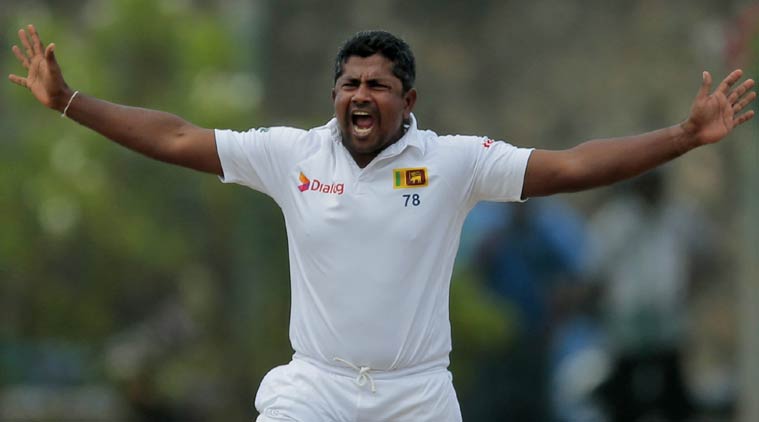 Rangana Herath has 384 Test wickets and went past Malcolm Marshall and Ian Botham in the recent Test against Zimbabwe.
The Dialog network claims they are the fastest broadband providers in Sri Lanka. It has, ironically, the slowest of slow bowlers around as the brand ambassador. In an amateurishly-shot reel, Rangana Herath peels out the features of the network in brisk but tuneful Sinhala. Herath, perhaps a trifle unaccustomed to the light and camera, is hurrying through the shoot, like the last bundle of files he has to rush through before closing time at the Sampath Bank in Colombo.
You find Herath at awkward spaces, places you least suspect him to invade. Like the top-25 catches of all time in YouTube, inhabited mostly by elastic men with toned-torso. Or like the cover of a business magazine, the preserve of debonair men in tuxedos. And at the top of ICC bowling charts.
 But Herath, unsuspecting and unassuming, has made a habit of surprising people—batsmen, teammates, commentators, and even his countrymen began to appreciate him belatedly. He’s like the less-appreciated tabla virtuoso in a Carnatic music concert, he whose rubbery fingers beat vigorously without a break, but summons notice only when he strikes a falsetto note.
Eventually, it took the most basic of all yardsticks of measuring a bowler to begin noticing Herath—wickets. After all, you better start appreciating someone who has taken 313 wickets, more than any other bowler post Murali’s retirement, at 25.41, orchestrated Murali-like capitulations at home, plotted unlikely heists like him, spun a memorable victory in England like him, and engineered what even the great Murali couldn’t, a Test win in South Africa.
In a sense, he fits into the archetypal Sri Lankan cricketing hero mould, a contrarian, a stand-out among teeming sameness. An uncomplicated man indifferent to the changes around him, content in his indifference to the world. It’s the non-conformity that makes him so compelling to watch—maybe, the romance would have been diluted if he were fit and young, and not round and middle-aged—as it was with Muralitharan, Arjuna Ranatunga, Lasith Malinga or the man who can do it all, the fictional Pradeep Mathew.
***
Herath’s deception begins without any filmy build-up. A reluctant amble to the crease, a micro-second pause to gather his frame for the clunky tilt and then an urgent but smooth release of the ball, like as if he’s throwing an apple at his best friend. The fingers looks pudgy. Nothing strikes even remotely innocuous for the batsman, unlike Murali, who hoodwinked the batsman first with his stirred, bulging eyes, then with his wicked wrist-flex and finally the contortions of the ragged red ball. Herath is the very antithesis of Murali.
The ball seems to float harmlessly, as if in a mid-noon siesta. Even after it pitches, it doesn’t draw oohs or aahs from the batsman. They think they have sized up the delivery. Only that Herath has already sized them up. Murali, in his wizardry mood, infused fear of an imminent end. Herath offers a slim but hollow illusion of survival. That you could avert the end if you did something different.
His art is not hypnotic like Murali’s. It’s a nagging craft of making the batsmen feel he has to do something different, and induce a mistake in the process. But if you don’t do something different, dot balls are wheeled away, claustrophobia can set in, and an unforced error would creep up eventually. So, damned, if you just sit quiet. Damned, if you try to do something different.
It’s an existential catch. “His quality is that he bowls at a spot, consistently, and tries to put the batsmen in pressure. And when a batsmen tries something else, he is successful because he has been honing on the same spot. He wants the batsmen to try something different. Else kha jayega– you are a sitting duck,” explains Ajinkya Rahane.
From sheer experience, Australia skipper Steve Smith would vouch for the same. Herath nailed him both times in the first Test in Kandy. But he was robustly confident he had learnt his lesson and offered a one-line solution to his befuddled teammates: “Get your pad out of the way”. For the deadliest of Herath’s weapon is the arm-ball that fizzes in. On a wickedly turning track, the straightness of the delivery is devilish.
Smith then devised an old-fashioned method to neutralise Herath. That is to cut him off the stumps and dishevel his line. It’s immensely risk-fraught, as Herath seldom bowls short or gives the requisite room. But if it can be pulled off, it will unsettle most spinners. It did to Murali when Rahul Dravid pivoted himself on the back foot and successfully cut the ball literally from the stumps and really fine.
But if only decoding Herath was as straightforward as that. “You think you have the measure of him, and then he starts bowling with an entirely different plan. It’s because he’s sharp enough to understand that the batsman is studying him and will be better equipped to deal with. So he changes the plan. So the key to play him is to play with a flexible mindset and out-read his mind,” says former left-arm spinner Maninder Singh. He’s like a mirage to the disbelieving eyes.
Smith’s thinking, though, was rigidly linear. The arm ball was perhaps playing on a loop in his mind. So, he was trying to play everything from inside the line of the ball. Just then, he was beaten off the outside edge, trying to drive the away-spinner pitched outside the off-stump. He foresaw the slider, but he didn’t second-guess that Herath had already second-guessed him. Herath played his part by landing the ball a couple of inches shorter than he generally does. Smith plopped back for the back cut, but the ball slithered in after pitching and rattled the stumps.
Smith perished twice more to Herath in the series, and left the Lankan shores giving Herath the ultimate Aussie stamp of approval: “He’s a very tough character.” “He’s always at you, he’s always at your stumps. He changes his pace beautifully and bowls from different parts of the crease, changes his angles up. You never really get a freebie off him or an easy boundary,” he added.
Smith was just stating the obvious. Almost every batsman in the world is aware of Herath’s methods, formulate plans to thwart him and put in plenty of practice hours. Rahane believes he can be rattled, if his rhythm is unsettled: “It’s important for the batsmen how you can change his (Herath’s) line and length. Every batsman will have his own way of course, but for me, it’s important that you find what are the best shots with which you can upset his rhythm.”
But once they land in Sri Lanka and begin countering this ever-smiling adversary, it’s as if they are suddenly smitten by collective panic. Sri Lanka skipper Angelo Mathews puts it more bluntly. “No matter how well you play spin, it is a nightmare facing Herath.” For the neutral, it’s an engrossing cat-and-mouse game, before he eventually teases the batsman to death. It’s nuanced ambush.
***
One sunny morning, Herath bumped into an old club-mate of his, who had shifted to Australia, at a petrol bunk in Colombo. After the hugs and pleasantries, he invited the friend over for breakfast and a drink. It was just about10 am. He’s a typical small-town Sri Lankan in that sense, values friendship and doesn’t mind a couple of drinks for ol’ time’s sake, un-strangled by dietary regulations or expanding waistline, without making too much fuss about training schedules or coach’s instructions.
All his life, he has never been a fitness freak, but that doesn’t necessarily imply that he isn’t fit or strong, or flexible. After all, slouchy men don’t take one-handed catches arching backwards like a rainbow (in fact, he has done it twice in international cricket). After all, lazy men don’t bowl 30-plus overs at a stretch, without showing any mental or physical strain.
It was as if bowling was the lone meaningful pursuit of his life. If he doesn’t have a ball in his hand, he restlessly fiddles with his fingers. “We used to call him a bowling machine,” recollects his former coach and good friend Chandika Hathurusinghe. “You didn’t need to tell him that, he would keep on bowling for hours.” But relentless bowing also meant that he developed strong shoulders and thick arms, besides stamina.
Hathurusinghe recalls trying to enlighten him about the virtues of fitness, especially if he wanted to bowl lengthy spells or to stretch his career. There had been times when he even lost his cool too. But Herath operated at his own whims and pace, like his own bowling, a slow lob arcing its way down with a mind of its own. After a point, Hathurusinghe let him be.
Maybe, he realised Herath needn’t do all these. “You see someone’s drive, you realise whether he can be a great player or just a good one. Rangana had it, and of course the talent too. He was also fiercely motivated. Even during the time Murali was at his peak and Herath not getting enough opportunities, he plugged away in domestic cricket, taking wickets and without complaining too much. He never lost sight of his dreams,” he says. Testimony to that is his 631 non-Test First-class scalps purchased between shifts and rare international look-in.
His ascent from obscurity to stardom is an instructive story of perseverance and self-belief, and how unaffected one should be despite newfound stardom. He has retained much of his traits over the years, the affability and cosiness, even the exaggerated belief in his batting abilities. “It was an experiment I had long given up,” says Hathurusinghe, Incidentally, he was introduced to Hathurusinghe by his brother as the “future Sanath”. But his batting never quite evolved, and mostly brings ironic cheers from the crowd, though he’s seldom short of ambition with the willow.
Once against England at Lord’s, with just an over to negotiate for a draw, he chose to intervene in the path of a bouncer that was heading down the leg-side and perished, leaving Nuwan Pradeep five nervous balls to fire-fight. Even his finest hour with the willow, against Australia in Galle, ended in writhing pain, when Josh Hazlewood struck him where it hurts the most.
***
Touring parties to Sri Lanka in Muralitharan’s era left the isle with baffled eyes. Now they leave with battered ego, as if they can’t fathom how Herath inflicted such lasting damage. Since Murali’s exit—their careers are so intertwined that comparisons and reference points are inevitable—he has plundered 213 wickets at 20.18 in just 30 matches. Murali’s average was a shade better, a wicket at 19.56 runs apiece and over a more sustained period of time (73 Tests).
But the point here is Herath is reaping wickets as regularly and routinely as Muralitharan used to. In three recent Tests versus Bangladesh and Zimbabwe, he took 27 wickets. Against Australia, he finished with 28 wickets, a tally no other left-arm spinner has ever managed, and only three other spinners of any hue has reaped in a three-Test series. The most remarkable effort perhaps was his 23-wicket haul in two Tests against Pakistan in 2014. “He just murdered us,” sighed a shocked Younis Khan.
It’s even more remarkable when you factor in the current plight of Sri Lankan cricket. Never since their World Cup triumph have their hopes hinged squarely on just one person. Murali had, in different phases of his career, the cunning left-arm pace of Chaminda Vaas as foil; the dazzle of Sanath Jayasuriya, the stability of Marvan Atapattu; the graceful brushstrokes of their batting trinity—Aravinda, Jayawardene and Sangakkara; the resoluteness of Hashan Tillakaratne and Thilan Samaraweera.
But now it’s just Angelo Mathews and Herath. And mostly just Herath alone, bore by the fact that he was adjudged man of the series in all of the last four home series. The last time he didn’t wheel away with the man-of-the-series plaque was when India toured them at around the same time in 2015. He still bowled them to a victory in Galle but finished with a modest (by his standards) 15-wicket haul.
The 7-for in the second-innings in Galle gave Ashwin, the eventual player of the series, the blueprint to bowl in Sri Lanka. He wasn’t trying to copy him, but incorporate the basic philosophy of his bowling. “There is a mile of difference between Herath and me. He doesn’t get as much bounce as I do. So, I go for a few more runs than he does. But I was basically looking to replicate what he did, that is to try and keep it within the stump line and try and see if I could get an odd ball to bounce,” he said after the series. He will be the one-man barricade for Team India.
Overseas bowlers flock to him for advice. Steven O’Keefe and Ashton Agar spent hours discussing the subtleties of the craft. So did South Africa’s pair of Steve Harmer and David Pleidt.. There is also a spin tutorial for beginners on a Lankan television channel, where he explains the basics of the craft. Maybe, once he retires, it doesn’t look imminent given the state Sri Lankan cricket finds itself in, he could embark on a successful coaching career too. But as of now, Herath is happy rubbing misery into touring batsmen, steering his country past a jerky transition, climbing up the ranking charts and endorsing high-speed internet devices.
***
History would remember him as not just the most prolific left-arm spinner of all time—it would take some catching up for Ravindra Jadeja, the second-most successful fellow tribesman (155 wickets) around, to usurp him. But also as someone who dusted up the game’s intrinsic simplicity.
Simple man, complex art
The soul of his craft is steadfastly orthodox. But the deception is rebelliously radical. His basic tools are good-old flight, drift and dip. Has just one variation. But he bowls round arm, doesn’t turn the ball big and square, procures more overspin than side-spin and fools the batsman chiefly with guileful variations in pace, flight dip and the deadly slider.
Classical Herath Dismissal
Most classical left-arm spinners prey with the outside edge of a right-handed batsman. But Herath targets their inside edge, a reason he gets a major percentage of them lbw or bowled. A classic instance was Steve Smith in the first innings at Galle. A few slow, flighted deliveries outside the off-stump later, one of which he was reprieved he bowled the arm ball, a tad quicker, faster and quicker on the off-stump. Smith shaped back for the back cut, trusting his bat-speed to guide the ball past third man. But it hustled into him and snuck through his gate to rattle the stumps.
The Stock Ball
Or his bait ball. The ball hangs interminably in the air. The unsuspecting batsman believes he has plenty of time (redundant time). The ball dips apologetically. It doesn’t explode off the surface, but harmlessly spins away. He lulls them with his slowness.
The Slider
Or his killer ball. The most potent of his weapons. More than it slides into the batsman, it goes straight after pitching. It’s incredibly difficult to discern it from the stock ball, unless the batsman has microscopic vision of his fingers. For the action and release points are much the same. So is often the pace and trajectory, which is not flattish like most contemporary left-arm spinners. astrutting round.
Man of Variations
He mixes up almost everything—pace, flight, drift, dip, length and line. He frequently changes his angles, his release points and the point of delivery. Not by conspicuous margins, but slim, subtle margins.
All Weather Man
Widely considered as someone who can prosper only on subcontinental turners, Herath has proved his effectivness abroad also. He spun Sri Lanka to a historic victory in South Africa, picking nine wickets in Durban, played a vital role in the win over England at Lord’s in 2014 and then prospered in Australia
Stay updated with the latest sports news across Cricket, Football, Chess, and more. Catch all the action with real-time live cricket score updates and in-depth coverage of ongoing matches.