Journalism of Courage



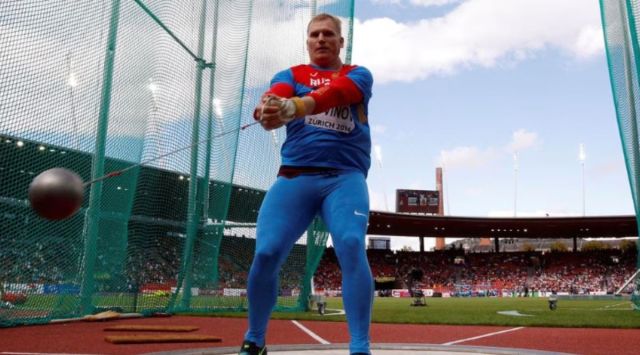 Sergey Litvinov of Russia competes in the men's hammer throw final during the European Athletics Championships at the Letzigrund Stadium in Zurich August 16, 2014. REUTERS/Phil Noble
 Former Russian hammer thrower Sergei Litvinov has admitted using banned substances and benefiting from his country’s cover-up system as athletics authorities handed him a two-year suspension and voided his past results.
“I took doping in 2012 and took profit from the cover-up system in Russia,” Litvinov, who no longer competes, wrote in a Facebook post on Thursday, a rare instance of an athlete admitting such an offence.
Litvinov, who missed the cut for Russia’s 2012 Olympic team, admitted to taking the anabolic steroids Oral-Turinabol and Oxandrolon between the end of April and the end of May of that year. He had previously said that he had never taken any banned substances.
Esto no lo había visto antes. Sergei Litvinov, lanzador de martillo ruso, admite haberse dopado en 2012 beneficiándose del encubrimiento del sistema ruso. Reconoce que el doping lo hizo mejorar pero que esto “no es deporte”. Pide disculpas por sus actos. pic.twitter.com/Pi1TWnKMwg
— Fernando Palomo ESPN (@fernandopalomo) January 12, 2023
Russia’s athletics federation was suspended in 2015 over a report commissioned by the World Anti-Doping Agency (WADA) that found evidence of mass doping in the sport.
A handful of Russian athletes were later cleared to compete at international events, including the Tokyo Olympics, but World Athletics, the sport’s governing body, subsequently banned Russians and Belarusians over the invasion of Ukraine.
Russian sports officials have acknowledged shortcomings in the country’s anti-doping system but have denied the existence of a state-sponsored scheme to cover-up positive doping tests. Litvinov, the son of Soviet hammer thrower Sergei Litvinov, the 1988 Olympic champion, said his throws improved by nearly two metres after taking the substances.
“The hammer was going further without a good feeling, or a good technique,” said Litvinov, who now lives in Germany.
Litvinov said he handed over the details of his case to the Athletics Integrity Unit (AIU), which oversees integrity issues in international athletics, including doping. The AIU said on Thursday that it had handed him a two-year ban and voided his results between July 2012 and Feb. 2016, effectively stripping him of his bronze medal from the 2014 European championships.
“I had pressure from the federation at the time, but at the end this was my decision and my fault,” he wrote, referring to Russia’s suspended athletics federation. “I want to say sorry to the athletics community.”
The Russian athletics federation issued a statement on the suspension but did not address Litvinov’s allegation that it had pressured him to use banned substances.










 3 min read