5 min read

© IE Online Media Services Pvt Ltd



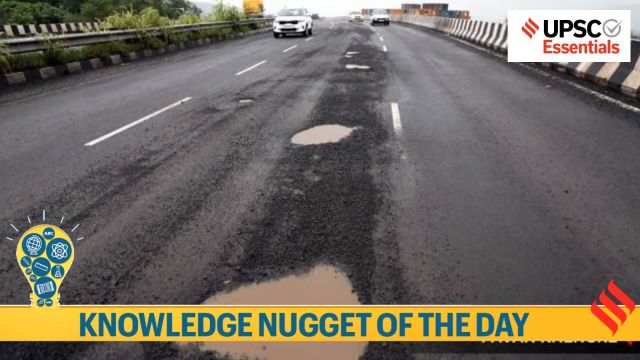 NHAI has faced criticism regarding the poor condition of NHs, which leads to accidents and fatalities if it is not maintained properly. (Express file photo by Pavan Khengre)
Take a look at the essential events, concepts, terms, quotes, or phenomena every day and brush up your knowledge. Here’s your UPSC Current Affairs knowledge nugget for today on Network Survey Vehicles (NSVs).
(Relevance: Various government initiatives are important for exams, especially those that are technology-driven and reflect India’s push towards data-based, transparent, and efficient infrastructure management. Thus, knowing about the NSV and other initiatives related to road management becomes essential.)
The National Highway Authority of India (NHAI) has announced that it will deploy Network Survey Vehicles (NSVs) in 23 states, covering 20,933 km of National Highways (NHs), for the collection, processing, and analysis of road inventory and pavement condition data. In this context, let’s learn about the NSVs and other important initiatives related to highway tolling and management.
Key Takeaways :
1. An NSV is usually a specialised van or SUV equipped with multiple sensors and instruments, such as Laser, Global Positioning System (GPS), Video image processing tools, High-resolution cameras, Inertial Measurement Units (IMU), and DMI (Distance Measuring Indicator).
2. These vehicles will collect data on the condition of NHs. The collected data will be further used to make decisions for pavement maintenance, asset management, and infrastructure planning.
3. Officials said that the data will be collected for all projects involving 2/4/6 and 8 lanes with NSV before the start of work and thereafter at regular intervals of six months.
4. The pavement condition surveys will be carried out using a 3D laser-based NSV system, which is capable of capturing and reporting road defects automatically without any human intervention, with the help of high-resolution 360-degree cameras and other tools.
5. Notably, NHAI has faced criticism regarding the poor condition of NHs, which leads to accidents and fatalities if it is not maintained properly. There are existing policy guidelines on surveying with NSV, which have been in place since 2019, mandating that the authority’s engineer and an independent engineer conduct surveys with NSV before issuing completion certificates for newly built highway stretches.
6. Now, with this new initiative, NHAI aims to collect all necessary data by conducting various surveys and accessing available data from concerned agencies, processing and analysing the same and uploading it on the Road Asset Management System (RAMS) in the prescribed format.
1. FASTag: It is an electronic toll collection system managed by the National Payments Corporation of India (NPCI) and the National Highways Authority of India (NHAI).
— FASTag sticker is usually pasted on the windscreen of a car. It was launched in 2014 as a pilot project and made mandatory at every toll plaza in the country in 2021.
— It uses Radio Frequency Identification (RFID) technology to communicate with scanners installed at toll plazas. Once the car crosses a toll plaza, the requisite toll amount is automatically deducted from a bank account or a prepaid wallet linked to the FASTag.
2. Datalake: Ministry of Road Transport and Highways (MoRTH) has developed RAMS (also called Datalake) to create a single road database for planning, budgeting, managing and maintaining the entire NH network in India through a systematic and scientific life cycle analysis.
3. Satellite-based Tolling System: In March, the Union Minister of Transport informed the Rajya Sabha that the government has deferred the proposed adoption of an ambitious Global Navigation Satellite System (GNSS) for toll collection.on account of privacy concerns.
— Under the GNSS, the toll collection system works with the help of satellites and on-board unit (OBU) fitted in vehicles, and the toll is calculated based on the distance traveled.
1. FASTag uses Radio Frequency Identification (RFID) technology to communicate with scanners installed at toll plazas. Once the car crosses a toll plaza, the requisite toll amount is automatically deducted from a bank account or a prepaid wallet linked to the FASTag.
2. RFID is a wireless tracking system that consists of tags and readers. Radio waves are used to communicate information/identity of objects or people to nearby readers – devices that can be hand-held or built into fixed positions like poles or buildings. The tags can carry encrypted information, serial numbers and short descriptions. There are also high-memory tags like the ones designed for use in the aviation industry.
3. There are different types of RFID tags: Passive tags, semi-passive tags, and active tags.
With reference to the FASTag, consider the following statements:
1. It is managed by the National Payments Corporation of India (NPCI) and the National Highways Authority of India (NHAI).
2. It was launched in 2014 as a pilot project and made mandatory at every toll plaza in the country in 2021.
3. In its new annual pass scheme, there is no limitation on the number of trips.
How many of the statements given above are correct?
(a) Only one
(b) Only two
(c) All three
(d) None
| Answer Key |
| (b) |
(Source: How will NHAI’s Network Survey Vehicles scour 20,000 km of highways for defects?)
Subscribe to our UPSC newsletter. Stay updated with the latest UPSC articles by joining our Telegram channel – Indian Express UPSC Hub, and follow us on Instagram and X.
🚨 Click Here to read the UPSC Essentials magazine for October 2025. Share your views and suggestions in the comment box or at manas.srivastava@indianexpress.com🚨


Read UPSC Magazine