7 min read


© IE Online Media Services Pvt Ltd



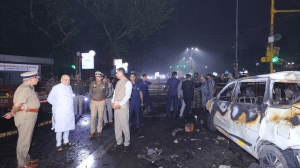
 Shah at the attack site near Pahalgam, Wednesday. (PTI)
Take a look at the essential events, concepts, terms, quotes, or phenomena every day and brush up your knowledge. Here’s your knowledge nugget for today. Today’s nugget focuses on Pahalgam terror attack.
(Relevance: The recent Pahalgam terror attack has been in the news, and with India taking major steps in response, this topic must be studied closely from multiple perspectives — especially those related to security issues and international relations. Beyond this news update, also refer to the timeline of major terror attacks in Jammu and Kashmir in recent years.)
 A day after the attack on tourists in Pahalgam, in which Pakistani terrorists took the lives of 26 people, Foreign Secretary Vikram Misri said on Wednesday evening, “The Indus Waters Treaty of 1960 will be held in abeyance with immediate effect, until Pakistan credibly and irrevocably abjures its support for cross-border terrorism,” .
India summoned Pakistan’s diplomat Saad Warraich Wednesday and was handed over a note verbale with all measures taken by the Cabinet Committee on Security (CCS) on Tuesday. Meanwhile, the Centre has called an all-party meeting in the Parliament today following the terror attack in Jammu and Kashmir’s Pahalgam on April 22, which killed at least 26 tourists and left several others injured. Defence Minister Rajnath Singh and Home Minister Amit Shah are expected to brief the leaders. Singh will chair the meeting. The decision to call an all-party meeting was taken on Wednesday, with Singh and Shah reaching out to various parties.
This comes a day after Prime Minister Narendra Modi chaired a meeting of the CSS — to take stock of the situation and deliberate on the government’s strategy amid rising terror attack tension.
Outcome of the Cabinet Committee on Security (CCS) meeting
Underlining “the cross-border linkages of the terrorist attack” in Pahalgam :
1. India “held in abeyance” the Indus Waters Treaty with immediate effect.
2. The Defence/Military, Naval and Air Advisors in the Pakistani High Commission in New Delhi are declared Persona Non Grata. They have a week to leave India. India will be withdrawing its own Defence/Navy/Air Advisors from the Indian High Commission in Islamabad.
3. Pakistani nationals will not be permitted to travel to India under the SAARC Visa Exemption Scheme (SVES) visas. Any visas issued in past to Pakistani nationals are deemed cancelled. Any Pakistani national currently in India under SVES visa has 48 hours to leave India.
4. Shut down the Attari border checkpost with immediate effect — those who have crossed over with valid endorsements may return through that route before May 1, 2025.
5. The overall strength of the High Commissions will be brought down to 30 from the present 55 through further reduction, to be effected by 01 May 2025.
| FYI : What is Cabinet Committee on Security (CCS) Story continues below this ad 1. With the Prime Minister helming it, the Cabinet Committee on Security (CCS) has the ministers for Finance, Defence, Home Affairs and External Affairs as its members. 2. It is responsible for debates, discussions and appointments of/ in the national security bodies. 3. Major decisions with respect to the significant appointments, issues of national security, defence expenditure of India are taken by CCS. 4. Besides dealing with defence related issues, the CCS also brainstorms on issues relating to law and order and internal security, and policy matters concerning foreign affairs on security-related issues. It also considers matters relating to atomic energy. |
Who claimed responsibility:
The Resistance Front (TRF), a shadow group of the banned Pakistan-based Lashkar-e-Taiba (LeT) terror group, claimed responsibility for the attack on the tourists in Baisaran, an off-road meadow in South Kashmir’s Pahalgam.
In January 2023, the Ministry of Home Affairs (MHA) declared the TRF a “terrorist organisation” under the Unlawful Activities (Prevention) Act for propaganda on terror activities, recruitment of terrorists, infiltration of terrorists and smuggling of weapons and narcotics from Pakistan into the valley. TRF began as an online entity in the aftermath of the abrogation of Article 370 and revocation of special status to J&K in August 2019.
The IWT was signed in Karachi on September 19, 1960, following nine years of negotiations between India and Pakistan. The Treaty has 12 Articles and 8 Annexures (from A to H).
According to the provisions of the Treaty, all the water of the “Eastern Rivers” of the Indus system — Sutlej, Beas and Ravi — shall be available for the “unrestricted use” of India. Pakistan shall receive water from the “Western Rivers” — Indus, Jhelum, and Chenab.
The Indus Waters Treaty lacks an exit clause, meaning neither India nor Pakistan can legally abrogate it unilaterally.
The Treaty has no end date, and any modification requires the consent of both parties.
But while the Treaty cannot be exited, it does contain a dispute resolution mechanism: Article IX, along with Annexures F and G, lays out procedures for raising grievances — first before the Permanent Indus Commission, then a neutral expert, and eventually, a forum of arbitrators.
| FYI : The two hydroelectric projects in Jammu and Kashmir that have been a bone of contention between India and Pakistan Story continues below this ad The two hydroelectric projects currently under construction in Jammu & Kashmir — the Kishenganga HEP on Kishenganga, a tributary of the Jhelum, and the Ratle HEP on the Chenab have been a bone of contention between India and Pakistan for years now, leading New Delhi to issue a notice, in January 2023 (first notice since six decades) and September 2024, to Islamabad seeking the “modification” of the Treaty. In its January 2023 notice to Pakistan, New Delhi cited Islamabad’s continued “intransigence” in implementing the Treaty. Both notices were issued under Article XII (3) of the IWT which states that “the provisions of this Treaty may from time to time be modified by a duly ratified Treaty concluded for that purpose between the two Governments”. Pakistan’s objection: Although they are “run-of-the-river” projects, which generate electricity without obstructing the natural flow of the river, Pakistan has repeatedly alleged that these violate the IWT. Its objection is on the design features. Story continues below this ad In January 2025, the Neutral Expert was appointed by the World Bank in 2022 under the terms of the IWT. He decided that he was “competent” to adjudicate on the differences between India and Pakistan regarding the design of two hydroelectric projects. |

Q. With reference to the Indus Waters Treaty (IWT) and recent developments, consider the following statements:
The Kishenganga and Ratle hydroelectric projects are located on the tributaries of the Ravi River.
India issued notices to Pakistan in 2023 and 2024 under Article XII (3) of the IWT seeking modification of the Treaty.
Pakistan’s primary objection to the Kishenganga and Ratle projects pertains to their status as storage-based dams.
Which of the statements given above are correct?
(a) 1 and 2 only
(b) 2 and 3 only
(c) 3 only
(d) 2 only
| Answer key |
| (d) |
(Sources: Pahalgam Attack Live Updates: After action against Pakistan, India summons its diplomat in Delhi (IE), What India’s suspension of the Indus Waters Treaty means for Pakistan — and for itself (IE))
Subscribe to our UPSC newsletter. Stay updated with the latest UPSC articles by joining our Telegram channel – Indian Express UPSC Hub, and follow us on Instagram and X.
🚨 Click Here to read the UPSC Essentials magazine for April 2025. Share your views and suggestions in the comment box or at Manas Srivastava 🚨


Read UPSC Magazine