3 min read
Stay updated with the latest - Click here to follow us on Instagram

Journalism of Courage



 Volcanic gases and ash billow from the peak crater of Mount Ontake in central Japan on Tuesday. (Source: AP photo)
Increased seismic activity raised concern Tuesday about the possibility of another eruption at a Japanese volcano where 36 people were killed, forcing rescuers to suspend plans to try to recover at least two dozen bodies still near the summit.
Volcanic tremors rose to a level not seen since Saturday evening, hours after Mount Ontake’s initial large eruption, said Shoji Saito of the Japan Meteorological Agency. The tremor levels were oscillating up and down.
“At this point, anything can happen,” Saito said, though he stopped short of predicting another large eruption.
 Increased seismic activity raised concern about the possibility of another eruption. (Source: AP photo)
About 80 to 100 relatives and friends of those who never returned from the summit were waiting for news in a municipal hall in the nearby central Japanese town of Kiso.
Rescuers found five more bodies on Monday, bringing the death toll to 36. They have managed to airlift only 12 bodies off the mountain since the start of the eruption on Saturday because of dangerous conditions.
There were believed to be at least 250 people on the mountain, a popular hiking destination, when it erupted.
How the victims died remains unclear, though experts say it was probably from suffocating ash, falling rocks, toxic gases or some combination of them. Some of the bodies had severe contusions.
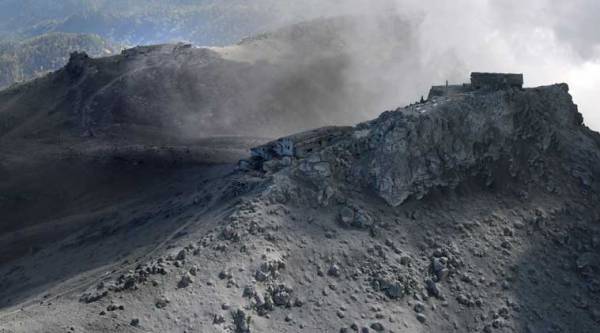 Dozens of people were killed by volcanic gases and smoke, forcing rescuers to suspend plans to try to recover at least two dozen bodies still near the summit. (Source: AP photo)
Survivors told Japanese media that they were pelted by rocks from the eruption.
Yuji Tsuno, a veteran mountain photographer, was near the summit. After taking pictures of the initial explosion as ash and debris rained down, he quickly took refuge in a nearby hut, he told the TBS TV network.
About 20 minutes later, when the smoke partially subsided, Tsuno rushed out and began his descent. It was a gamble, but he believed it was his only chance, he said.
 Japanese Ground Self-Defense Force’s helicopter in Otaki in Nagano, central Japan, on Tuesday. (Source: AP photo)
“I almost thought it was the end of my life,” he said in the interview.
On his way down, he spotted a man heading up. “I told him to go down with me, but he said he had to check on his child up there. I couldn’t stop him,” Tsuno said.
The eruption caught seismologists by surprise. Although somewhat increased seismic activity had been recorded for about two weeks, there were no indications of a major eruption, said Satoshi Deguchi, a Japan Meteorological Agency official in Nagano prefecture. Typical signs, such as increased seismic rattling or underground structural movement, were not detected.
The eruption was the first fatal one in modern times at the 3,067-meter (10,062-foot) mountain, located about 210 kilometers (130 miles) west of Tokyo. An eruption occurred in 1979, but no one died.
Stay updated with the latest - Click here to follow us on Instagram