12 min read
Stay updated with the latest - Click here to follow us on Instagram

Journalism of Courage



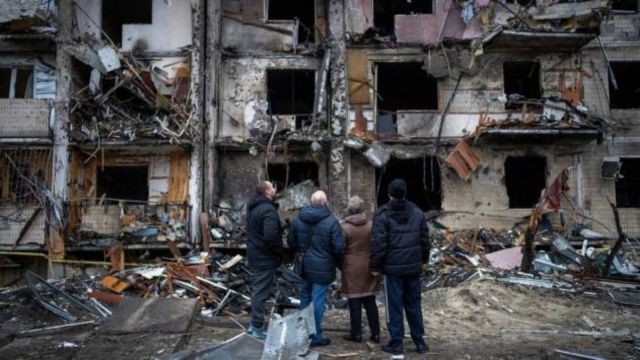 People look at the damage following a rocket attack in the city of Kyiv. (AP)
Iryna Hrushkovska’s grocery store is just a hole in the ground now, and her house a pile of rubble — the seventh from the corner. The whole neighborhood is an eerie grid of nothing, much like the rest of Marinka, the city where she was born and raised.
“If I shut my eyes, I can see everything from my old life,” says Hrushkovska, who is 34. “I can see the front gate. I can walk through the front door. I can step into our beautiful kitchen and look into the cupboards.”
“But if I open my eyes,” she says, “it’s all gone.”
Few countries since World War II have experienced the level of devastation visited on Ukraine in a little over two years of full-scale war. But it’s been impossible for anybody to see more than glimpses of it. It’s too vast. Every battle, every bombing, every missile strike, every house burned down, has left its mark across multiple front lines.
Drawing on detailed analysis of years of satellite data, The New York Times was able to establish a record of each town, each street and each building that has been struck. The result is the first comprehensive picture of where the Ukraine war has been fought, and the totality of the destruction.
The scale is hard to comprehend. More buildings have been destroyed in Ukraine than if every building in Manhattan were to be leveled four times over. Parts of Ukraine hundreds of miles apart look like Dresden, Germany, or London after World War II, or the Gaza Strip after half a year of bombardment.
To produce these estimates, the Times worked with two leading remote sensing scientists, Corey Scher of the City University of New York Graduate Center and Jamon Van Den Hoek of Oregon State University, to analyze data from radar satellites that can detect small changes in the built environment.
More than 900 schools, hospitals, churches and other institutions have been damaged or destroyed, the analysis shows, even though these sites are explicitly protected under the Geneva Conventions.
These estimates are conservative. They don’t include Crimea or parts of western Ukraine where accurate data was unavailable. The true scope of destruction is likely to be even greater — and it keeps growing. In mid-May, the Russians bombed some towns in northeastern Ukraine so ferociously that one resident said they were erasing streets.
Ukrainian forces have caused major damage, too, by bombing front-line Russian positions and attacking Russian-held territory like Crimea and Donetsk city. While it is not always possible to determine which side is responsible, the devastation recorded in Russian-held areas pales in comparison to what is seen on the Ukrainian side.
The Kremlin referred questions about this article to Russia’s Defense Ministry, which did not respond.
 Lyudmila Omelicheva, 74, stands inside her house that was heavily damaged by recent shelling, which local Russian-installed authorities called a Ukrainian military strike, in the course of Russia-Ukraine conflict in Donetsk, Russian-controlled Ukraine (Reuters)
Few places have been as devastated as Marinka, a small town in eastern Ukraine.
Comprehensive School No. 1, where so many young Ukrainians learned to write their first letters, has been blown apart. The Orthodox cathedral, where couples were married, has been toppled. The chestnut-lined streets where generations strolled, the milk plant and cereal factory where people worked, the Museum of Local Lore, the Marinka Region Administration Building, go-to shops and cafes — all landmarks for generations — have been reduced to faceless ruins.
The damage runs into the billions, but the true cost is much higher. Marinka was a community. Marinka was living history. Marinka was a wellspring for families for nearly 200 years. Its erasure has left people feeling lost.
Before everyone fled, when a strong wind came from the west, the people in Marinka used to do something slightly provocative: They would tie a yellow and blue Ukrainian flag to a helium balloon and float it across the nearby front line to land somewhere in Russia-controlled territory.
“True Ukrainians lived here,” said Hrushkovska’s mother, Hanna Horban. “They worked in the fields and factories, they created their future and the future of their children. They lived under a Ukrainian sky, free and our sky.”
Reminiscing about her old town makes her eyes well up. Sometimes, she says, she sees Marinka in her dreams.
It’s the same for many others. A young Ukrainian woman in Berlin recently opened a photo exhibition on Marinka. Videos have surfaced on social media featuring photos of prewar Marinka with sad music playing in the background. Some of Marinka’s displaced people have chosen to hang together in another town, Pavlograd, 100 miles away.
In many ways, the story of this one town — its closeness, its vulnerability and its ruin — is the story of this war and perhaps all wars.
 A Ukrainian serviceman walks near destroyed building, amid Russia’s attack on Ukraine, in the frontline town of Chasiv Yar in Donetsk region, Ukraine. (Reuters)
The Horbans settled down in Marinka at least three generations ago. By the early 1970s, when Ukraine was still part of the Soviet Union, they had built their own house at 102B Blagodatna St. It was large, by Soviet standards: around 1,200 square feet, with three bedrooms and bright red tiles leading to the front door. In the yard, they raised ducks, chickens, two cows and two pigs; they grew all kinds of vegetables, from potatoes to peas; and they plucked apples, cherries, peaches and apricots from their own trees.
“In the 1990s,” Hrushkovska said, “we survived off this.”
Marinka started out as a farming hamlet, founded in 1843 by adventurous peasants and Cossacks from the Eurasian steppe. Legend has it that it took its name from the founder’s wife, Mariia.
By the early 20th century, this entire swath of eastern Ukraine transformed. Iron and coal were discovered, in a region soon to be called the Donbas, and the city of Donetsk became an industrial hub. Marinka, about 15 miles away, shifted from a quiet farming town to a busy suburb.
By the mid-1960s, it had a coal mine, a milk factory, a tire factory, a bread factory and soon a museum, a public sauna and two public pools.
In the spring, the back lanes smelled of fresh flowers. In the summer, children swam in the Osykova River. In the fall, workers piled into trucks heading for the collective farms and harvested immense amounts of wheat, afterward swigging vodka straight from the bottle and dancing in the stubbly fields. The best restaurant in town was Kolos, known for its “Donbas cutlet,” a cut of high-quality pork, breaded and cooked with a hunk of butter.
“Marinka was blooming,” said Horban, who was also born there.
When the Soviet Union collapsed in 1991, Marinka sank into disorder. State-owned enterprises shut down and Horban’s husband, Vova, a veterinarian, lost his job and had to dig coal for a living, at age 40.
Things stabilized by 2010. Bolstered by trade with Russia, Donetsk developed into one of Ukraine’s swankier cities. Marinka prospered by extension and grew to around 10,000 people.
In the spring of 2014, everything changed, again.
“All of a sudden strange men appeared with weapons and started stealing cars,” said Svitlana Moskalevska, another longtime resident.
That was just the beginning. Violent protests broke out. Then shooting in the streets. The Russians were backing an insurgency in Donetsk. It was confusing. And terrifying.
By mid-2014 — after thousands were killed, including dozens in Marinka — Donetsk had become the capital of a new Russian puppet state, the so-called Donetsk People’s Republic. For several months, Marinka was occupied as well.
The Ukrainian army eventually cleared Marinka, but it wasn’t strong enough to take back Donetsk. So the front line between Ukraine and Russia cut right through Marinka, less than a mile from the Horbans’ home.
People shut themselves in at night and drew their curtains, fearful of being shelled. Basic services collapsed. Marinka used to get treated water from Donetsk, but the Russians cut off the pipes, leaving it no choice but to hook up to the Osykova River.
“It was disgusting,” said Olha Herus, Horban’s cousin. “Fish came out of the faucet, sometimes even little frogs.”
On Feb. 24, 2022, when Russia launched a full-scale invasion of Ukraine, one of the first places it attacked was Marinka. This time, the Russians bombed the town with aircraft and heavy artillery, causing far greater damage than in 2014.
 Residents carry their belongings near buildings destroyed in the course of Ukraine-Russia conflict, in the southern port city of Mariupol, Ukraine (Reuters)
Hrushkovska and her daughter, Varvara, evacuated a few days later. Some older residents, including Herus’ mother, Tetiana, refused to leave. She told everyone that she had become an “expert” at identifying the different types of munitions flying around — artillery, mortars, tank rounds, hand grenades, airplane bombs. She assured her family that she always knew when to seek shelter in the vegetable cellar. But at a deep level, it seemed she simply didn’t want to leave.
“You have to understand,” Herus explained. “In Ukraine, people don’t like to move from one region to another. This is the mentality. We like living in one house for three to four generations.”
On April 25, 2022, Herus’ mother called and uttered two words no one could recall her using before: “I’m scared.”
An hour later she was killed.
The White Angels, a volunteer paramedic group, evacuated Marinka’s last residents in November 2022.
Ukraine’s military lost Marinka in December 2023.
They had been fighting for the city since 2014. Hundreds if not thousands of men from both sides died for it. At the very end, a small group of Ukrainian soldiers were holed up on the western edge of town in a warren of tunnels and pulverized basements. The rest was Russian territory.
When the Ukrainians peeked their heads out, they were stunned.
“I saw a picture of Hiroshima, and Marinka is absolutely the same,” said one Ukrainian soldier, Henadiy. “Nothing remains.” Following military protocol, he provided only his given name.
Another soldier, who asked to be identified by his call sign, Karakurt, described cars with the paint scorched off, houses cut down to their jagged foundations and long, empty roads that sparkled with glass and smelled of dust, smoke and gunpowder.
“Whatever could burn, burned,” he said.
Ukraine is determined to rebuild. The hope, however distant, is that with international cooperation Ukraine will seize Russian assets and force Russia to foot the bill for the reconstruction of entire cities like Marinka.
But a long war may still stretch ahead. In recent months, the Russians have had the upper hand, destroying more communities as their army seems to stagger inexorably forward. Ten million Ukrainians have fled from their homes — 1 in 4 people.
Last spring, a few dozen people from Marinka gathered at a school in Pavlograd, which is considered reasonably safe. The children wore crisply ironed embroidered shirts called vyshyvankas. In a large room with big windows, they performed dances and sang patriotic songs that were beamed by video to displaced Marinka people around the world. Adults stood along the wall, tears dripping down their faces.
“You know the simplest way to make a person cry?” Hrushkovska asked. “Make them remember their city and their home.”
She and her daughter, Varvara, 13, are squeezed into a small two-room apartment in Pavlograd.
“My old kitchen was bigger than this whole place,” she joked.
Then she broke into tears.
Hrushkovska grew up in Marinka. She was married in Marinka. She raised Varvara in Marinka. Her grandparents died in Marinka. She knows she can never go back to Marinka. She senses that for the rest of her days, she will suffer from something that has no cure: everlasting homesickness.
She is considering moving abroad with her daughter.
“No matter how unpatriotic it may sound, there’s not much future for her in Ukraine,” Hrushkovska said.
“It’s not that we want to leave,” she quickly added. But with Marinka gone, she said, “we don’t know where else to go.”
Stay updated with the latest - Click here to follow us on Instagram